Some advice to help ease the way for snow removal crews
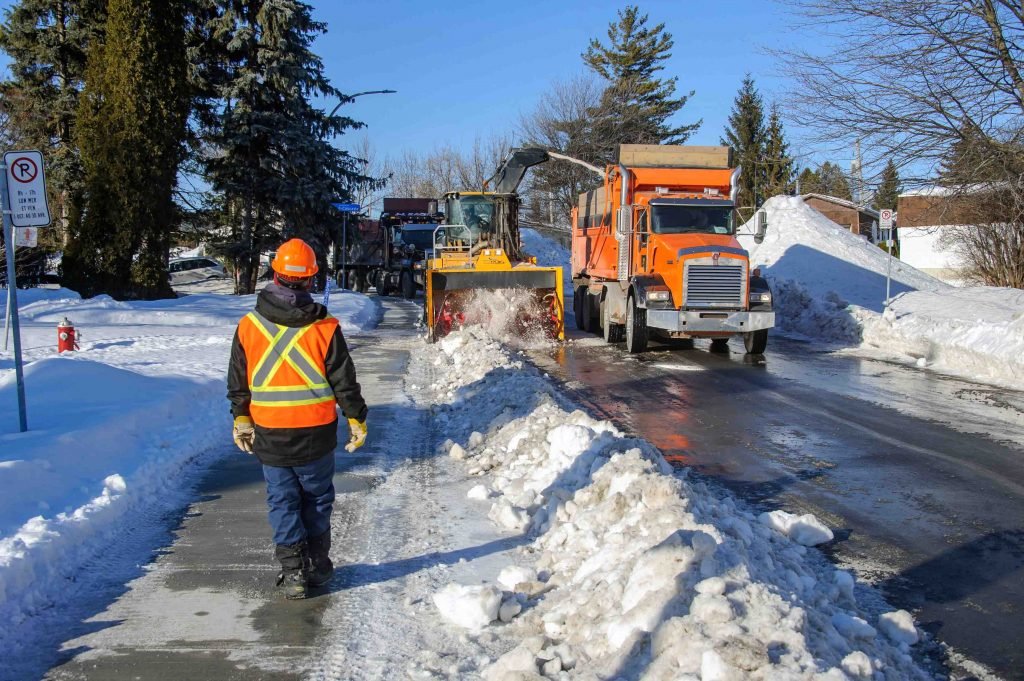
The City of Laval’s snow removal crews were still hard at work earlier this week, removing the latest covering of white stuff that mother nature left behind. In all, last week’s storm was the third major snow event the city has had to contend with this winter.
Read the signs
As always, officials with the city are reminding residents that in order to maximize the efficiency of snow removal operations, the public’s cooperation is needed, especially with regards to street parking and allowing snow removal crews to get their job done.
With that in mind, snow removal warning notices and signs should always be heeded. The best thing to do on days when snow crews are scheduled to pass along your street is park in your own driveway.
Careful when parking
If parking on the street before crews are scheduled to pass, your vehicle should be parked around 30 centimetres from the curb so that the sidewalk snow plow can pass by safely, while being careful not to obstruct street traffic passing by. It is also recommended to shovel snow onto your own property, rather than onto the street or sidewalk. As well, garbage, recycling and kitchen waste bins should be placed just on the edge of your property where they won’t interfere with snow removal operations.
Laval City Council Meetings open to the public again
The City of Laval has announced that citizens may once more attend in person the municipal council meetings.
The next meeting, which will take place on March 1, will welcome council members and citizens wishing to attend and ask questions.
In order to comply with sanitary measures, the wearing of a face covering will be required at all times.
Citizens wishing to attend the session and ask their questions will be able to download the online form at laval.ca or fill it out on site during the period provided for this purpose.
Please note that the Laval City Hall offices are currently located at 3131 Saint-Martin Boulevard West. Citizens will still be able to follow the debates live at webdiffusion.laval.ca from 7 p.m.
Question Period
To ask a question to the elected members of the municipal council on March 1 , citizens must arrive between 6 p.m. and 6:45 p.m . at Laval City Hall and submit the form previously completed or will be able to fill one out on site. The Registration Form for Citizens’ Question Period is available at https://www.laval.ca/Documents.
Clause-by-clause study of language law quickly gets controversial
Raquel Fletcher in Quebec City
As the adage goes, the devil is in the details and Bill 96, the government’s proposed French language reform legislation has a lot of details. The National Assembly committee studying the bill is in the clause-by-clause stage, a meticulous and methodic process of analyzing its 201 articles.
Quebec City correspondent for Global Raquel Fletcher.
It didn’t take long for things to get controversial.
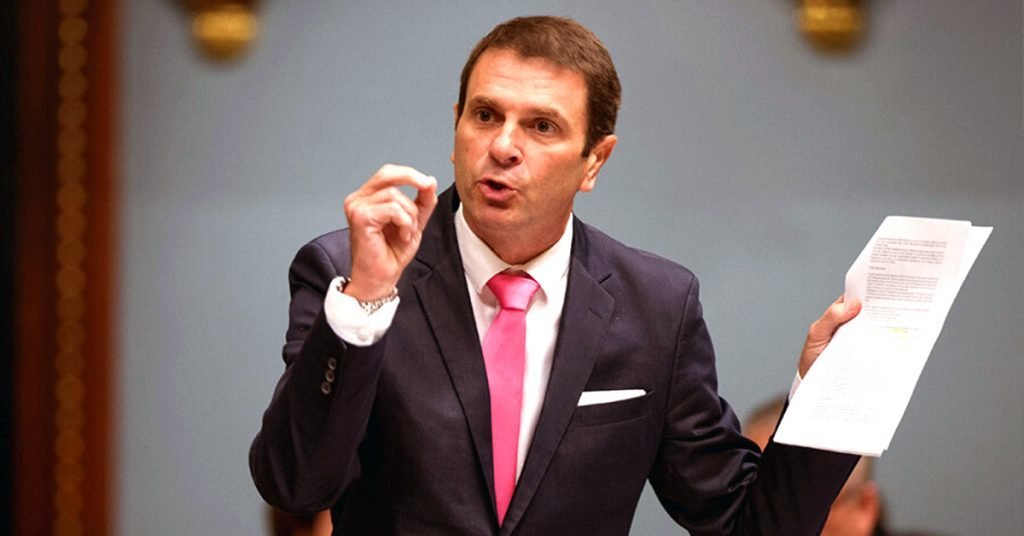
During its committee work Thursday afternoon, Liberal MNA David Birnbaum called out French Language Minister Simon Jolin-Barrette about an article concerning temporary foreign workers.
“I have to learn how to say, ‘red herring’ in French because there are 500 kilograms of it in this room,” he said.
Under the current law, temporary foreign workers can apply for an exemption to Bill 101 to send their kids to school in English. Bill 96 aims to limit that exemption to three years. JolinBarrette said this modification would provide an incentive to workers who suspect they might stay longer or even apply to become permanent residents to send their kids to school in French from the beginning.
The minister argued it would facilitate their integration faster. It also closes a loophole in the law by which immigrants could theoretically use the temporary worker route instead of applying through the regular immigration process to strategically bypass Bill 101. Children who are granted exemptions could potentially gain an acquired right to be able to send their own children and grandchildren to English school.
Birnbaum said framing the issue this way is offensive because it paints immigrants as being antagonistic towards the protection of the French language.
“I have to say, if I was currently a temporary worker and I heard this, I would be pretty insulted by these allusions that suggest I am somehow hostile to French in Quebec or that I’m part of some spontaneous army that has descended on Quebec in order to anglicize this corner of North America,” he said in committee.
The red herring, he said, is that the number of people taking advantage of this theoretical loophole is probably marginal, although the minister failed to provide numbers. “This discussion on temporary stays in Quebec is emblematic of the key issues before us in trying to find positive and inclusive ways to promote the French language,” Birnbaum said in a phone interview.
The discussion so far has not been positive, nor inclusive, he said, pointing out that this reform could seriously hurt the Quebec economy.
Skilled workers may move elsewhere
The Bill 101 exemption for temporary stays encourages highly skilled workers, including academics and scientists to work in Quebec because they know they will be able to send their kids to school in English. In exchange, the province benefits from their expertise. However, without the possibility to renew the exemption, this highly skilled workforce may choose to move elsewhere.
The Liberal Party is proposing an amendment to allow for one renewal, so children of temporary workers could attend English school for a maximum of six years. However, Jolin-Barrette indicated he would not adopt this amendment. The article was included “because there’s a hole in the law,” he said.
Then switching to English, he asked Birnbaum directly, “There’s a breach in the law. You don’t want to fix it? You want to let it happen?”
In a cheeky retort, Birnbaum once again asked the minister to quantify the size of this supposed hole. “Is it a pothole or is it the Quebec tunnel?” he asked, referring to the government’s controversial third link project for Quebec City.
The committee has been studying this bill for about 60 hours. It is a quarter of the way through the legislation. It has already adopted an article which gives immigrants a six-month window to learn French. After that, the public service must only communicate in French in written correspondence with immigrants. Debate around even more controversial aspects of Bill 96 is yet to come, including special provisions for the Office québécois de la langue française to conduct searches and seizures.
I listened to Canada’s National Anthem when our Women’s hockey team won gold last week, with their glowing full teeth smile. We were all so proud of them, playing all out for 60 minutes of every game of the tournament. They were doing it as a team, riveted to their system of play, supporting each other in corners, protecting their goalie, playing two-way hockey like I have not seen some NHL teams perform this season.
Newsfirst Multimedia political columnist Robert Vairo.
And then my attention focused on the Anthem, as the women stood proudly displaying gold around their neck. “True patriot love in all of us command” jarred me to reality. It suddenly sounded empty. I sometimes sing the anthem out loud to celebrate ‘the thrill of victory’, winning gold, being the best in the world. Not this time. I could not bring myself to sing because like most of us, I also had an eye on the scenes from the Ottawa occupation. A news junky, hungry for coverage from different sources, live where possible, lap tops, the desk top, and the phone close by, I perhaps saw too much of what Canada has become. And I did not like it.
How has it come to this? It should come as no surprise that an anti science, anti government movement has been growing for years, brought to the surface and becoming more evident by the pandemic and its accompanying vaccines, and ever changing and often conflicting restrictions. Alienated and frustrated for not having a voice nor a choice, we are seeing open aggression and death threats towards health care workers, journalists, politicians, grocery, restaurant and store employees. Reporters and private health care providers remove corporate logos from their cars for their own safety.
This may be a sign of the times. The Ottawa protests could have been avoided with political leadership in Canada, and not one that is consistently divisive. And because of our proximity to the Americans, the importation of their alt right extremism and violence seems inevitable.
There was debate in the House of Commons, something we have not seen with the Trudeau liberals since the pandemic began two years ago. It was not pretty. The fangs were out on both sides but at least democracy is functioning.
As the protest morphed into occupation (trucks blocking main streets for weeks, and a base camp set up is not a protest) we quickly realized the police force was initially understaffed (so much for ‘defund the police’ movement). They were unprepared and led by an overwhelmed police chief who was eventually forced to resign. So, enraged citizens took it upon themselves to step up. They formed their own counter blockades, and one obtained an injunction that would stop the tormenting horn honking, thanks to a 21-year-old civil servant Zexi Li. And eventually the “freezing of digital assets and bank accounts of convoy leaders,” that fueled the Ottawa chaos.
Perhaps it has been building for some time but it seems in just the last few years there has been “political instability, a changing economy, racism in our schools and communities,” and most significantly, a loss of importance and significance of Canada among world nations.
We also realized our current laws are apparently not sufficient to deal with this unprecedented protest, unprecedented occupation, a potential insurgency. The arrested leaders wanted to have an un-elected seat in government. The frustration and alienation are understandable, and so is a peaceful protest, but the aggression promoted by the growth of extremists and foreign interference is not. Our governments and police forces were not prepared, until the 22nd day.
There was a plethora of surveys available detailing Canadians’ opinions during the occupation. “Three Quarters of Canadians Want Protestors to go Home.” Another headline read “Large majority in Ottawa Oppose Freedom Convoy,” and, “Are you in Favour of Invoking the Emergencies Act?”.
But there were no surveys asking how the convoy became “a melting pot for individuals with a wide variety of grievances,” and misinformation. No surveys asking Canadians how do we fix this? How do we change, and, what new direction do we take? How do we become “strong and free” again?
The point is, this is not the country I knew. Sweet, peaceful Canada has come to an abrupt halt.
This is not the first time we have faced such polarization. Canadian history is full of well-known events that have led to changes, usually but not always for the better.
In the end, declaring the Emergencies Act may just be a pause in the next display of populist anger.
ADDED NOTE:
$15 million per day is the loss to retailers because of the “Freedom Convoy.” That does not include the cost of the tri level police forces from across Canada. Perhaps more important than monetary, the emotional cost of keeping a city hostage, with noise, belching diesel fumes, insults, and intimidation of masked pedestrians, even menacing children in school yards.
Ex-RCMP officer, assigned to guard Trudeau, identified as a senior organizer
The Canadian Security Intelligence Service’s ITAC unit warned late last month, just before the Freedom Convoy staked out Parliament Hill, that protesters, including some extremists, “could use rudimentary capabilities, such as trucks, cargo and fuel, to cause disruptions to infrastructure,” according to a report by the U.K.-based Guardian newspaper.
Threat underestimated
The Integrated Terrorism Assessment Centre (ITAC) is a federal organization within CSIS, responsible for assessing worldwide terrorism threats to Canada and Canadian interests. According to a description on the ITAC website, its purpose is to provide support for the decision-making needs of senior federal leaders.
A report generated by ITAC on the Freedom Convoy, which The Guardian claimed last week to have seen, stated that the Ottawa Police Service – which has a mandate to provide overall security in the nation’s capital – was warned of the imminent arrival of the Freedom Convoy, although it later emerged that the OPS underestimated what they would be dealing with.
Canada’s ‘January 6’
As cited by The Guardian, the ITAC report said supporters of the convoy “advocated civil war,” called for violence against Prime Minister Justin Trudeau and said the protest should be “used as Canada’s ‘January 6’”, which was a reference to the storming of the United States Capitol in Washington DC in early January last year.
“Extremists and other individuals supporting Covid-19 conspiracy theories and violent anti-authority/anti-government views have expressed intent to participate in the convoy and to attend the accompanying protest in Ottawa,” The Guardian said, quoting from the ITAC report.
$5,000 or five years jail
Police in Ottawa worked to remove protesters, some of whom had been camped in their trucks near Parliament Hill for weeks. (Photo: Newsfirst Multimedia)
Last week, during a webcast briefing on the government’s enactment of the Emergencies Act in which Newsfirst Multimedia participated, senior administrative officials with Public Safety Canada outlined the consequences for protesters defying orders to leave Ottawa, including $5,000 fines or five years in jail. The same penalties could also be applied to anyone bringing aid to participants such as food or fuel.
While the Emergencies Act covers four types of threat, the second, known as a Public Order Emergency, is being used, and is defined as being “for an emergency that arises from threats to the security of Canada and that is so serious as to be a national emergency.”
Defining a Public Order Emergency
The Emergencies Act classifies any or all of these threats as a Public Order Emergency:
(a) Espionage or sabotage that is against Canada or is detrimental to the interests of Canada or activities directed toward or in support of such espionage or sabotage;
(b) Foreign influenced activities within or relating to Canada that are detrimental to the interests of Canada and are clandestine or deceptive or involve a threat to any person;
(c) Activities within or relating to Canada directed toward or in support of the threat or use of acts of serious violence against persons or property for the purpose of achieving a political, religious or ideological objective within Canada or a foreign state;
(d) And activities directed toward undermining by covert unlawful acts, or directed toward or intended ultimately to lead to the destruction or overthrow by violence of the constitutionally established system of government in Canada.
Officials requested anonymity
The list of threats cited as justification to invoke the act does not include lawful advocacy, protest or dissent, unless the latter take place in conjunction with any of the activities referred to in paragraphs (a) to (d). Such was the overall state of alarm hanging over the nation’s capital last week that Public Safety Canada asked media to not identify its experts and spokespeople.
The Emergencies Act regulations listed the places where blockades are no longer being allowed, including Parliament Hill and the streets around it where there are many federal buildings, airports, harbours, border crossings, piers, lighthouses, canals, interprovincial and international bridges, hospitals, trade corridors and infrastructure needed for the supply of utilities including power generation and transmission.
Accounts ordered frozen
A special order on emergency economic measures also gave powers to police, banks and insurance companies to freeze accounts and cancel vehicle insurance policies belonging to people deemed to be protesters and who refused to cooperate by leaving when ordered.
As well, the Emergencies Act designated towing companies as an essential service that can be ordered by police to remove trucks, failing which tow trucks can be seized to allow police to complete the task themselves.
‘Extremists and other individuals supporting Covid-19 conspiracy theories and violent anti-authority/anti-government views have expressed intent to participate in the convoy,’ stated itac’S report
The New York Times reported last week that a team of leaders from Freedom Convoy 2022 worked out of operational centres located in hotel rooms a short distance from Parliament Hill, “some with military and right-wing organizing backgrounds,” who “orchestrated a disciplined and highly coordinated occupation … It is a crew that includes former law enforcement officers, military veterans and conservative organizers …”
Convoy leader guarded PM
On Feb. 9, CBC News identified the chief of security for Freedom Convoy 2022 as Daniel Bulford, a former RCMP officer who was on Prime Minister Justin Trudeau’s personal bodyguard detail until last year. According to the CBC, Bulford quit after refusing to be vaccinated against COVID-19.
CBC News also identified two other senior Freedom Convoy organizers as former law enforcement officers or military veterans. Tom Quiggin, a former military intelligence officer also worked with the RCMP and was considered one of the country’s top counter-terrorism experts. And Tom Marazzo, identified as an ex-military officer who served in the Canadian Forces for 25 years, now works as a freelance software developer, said the CBC.
Vimy MP calls for Ottawa’s Wellington St. to be closed permanently, following ‘Freedom Convoy’ crisis
During an anticipated Parliamentary investigation into the “Freedom Convoy” which occupied Parliament Hill for more than three weeks, Vimy Liberal MP Annie Koutrakis says she will be recommending that Ottawa’s Wellington Street be closed off permanently in front of the Parliament buildings to reinforce the safety of the country’s government and MPs.
‘Shut Wellington’
“I would like to see Wellington shut down to the public, to be honest with you,” Koutrakis said in an interview with The Laval News earlier this week, as a consortium of police forces from several provinces were removing the last of the protesters and their trucks from a grid of streets occupied in central Ottawa by the Freedom Convoy since late January.
A bird’s eye view of Freedom Convoy 2022, looking west along Wellington St. in downtown Ottawa, a block or so from Canada’s parliament buildings.
“Whether that becomes a pedestrian walk, whether that means there’s going to be checkpoints from a certain spot – I was thinking maybe from Elgin Street all the way down to Bank Street – we need to secure that area,” she said.
“Could you imagine this happening on Pennsylvania Avenue around the Capitol in Washington D.C.?” added Koutrakis, alluding to the events there on January 6 last year when Trump supporters stormed the seat of elected government in the U.S.
MPs needed protection
Although Koutrakis herself was working from home in Montreal during the time the siege of Ottawa’s downtown area was underway, she said many other parliamentarians who were in the nation’s capital over the past few weeks had to be escorted by special security through the chaos along Wellington St. in order to be able to take their seats in the House of Commons.
Koutrakis said MPs who planned to enter the Parliament buildings were advised to not wear their identifying parliamentary member’s lapel pin. She said they were also told not to wear protective face masks while passing through the crowds, since protesters were reported to have threatened people with face masks on. She said she respects the rights to free speech and to demonstrate publicly, but added that she is not happy about illegal aspects of the occupation.
Investigation coming
“This turned out to be something very different,” she said. “There will be an investigation. And I am confident that once the investigation is over, we as Canadians are going to be very surprised and disappointed to see what factions were at play. I’m disappointed to see how, as Canadians, we could be so divided. I’m disappointed to see that people think that we have conquered Covid.
“Covid is still here. Yes, we have more tools now to deal with it, but we don’t resolve issues by, you know, going to Ottawa and disrupting people’s lives and saying that a democratically-elected government five months ago should step down and that the governor-general and three leaders of the convoy should step in. That’s not our democracy. That’s not the Canada that I know.”
Plan to take over capital
Regarding the emerging evidence that at least three of the Freedom Convoy’s senior organizers were former law enforcement officers and military intelligence veterans (including an ex-RCMP officer who was assigned to the Prime Minister’s bodyguard detail), Koutrakis said, “One doesn’t have to be a brain surgeon to realize that this involved some very well thought-out, highly-organized planning to take over our capital. It’s very disturbing to find out.”
Concerning the Ottawa Police Service’s failure to deal effectively with the crisis even though this was its mandate, she said, “There’s no question that the Ottawa Police unfortunately were not prepared. I don’t know if they didn’t have the proper intelligence. And if they didn’t have the proper intelligence, it begs the question why nothing was done. Why were they not better prepared to shut it down?”
Safeguarding Parliament
She suggested that if a need is seen for a new agency, on a more permanent basis, to make sure the Parliament Hill area is safe from serious threats, then the federal government should look into forming a new security unit with that specific mandate. “I don’t know how much if that is federal jurisdiction,” said Koutrakis.
I am confident that once the investigation is over, we as Canadians are going to be very surprised and disappointed to see what factions were at play
“I would imagine, because of jurisdiction, it would be mostly the city which is a creation of the province. But one has to wonder: Where was the province, where was the city? There was a huge failure, a huge breakdown and I think that we need to really dig down deep to find out what happened.”
The current issue of the Laval News volume 30-07 published February 23rd, 2022. Covering Laval local news, politics, sports and our new section Mature Life. (Click on the image to read the paper.)
Front page of the Laval News, February 23rd, 2022 issue.
Officers with the Laval Police Department issued more than 3,000 tickets since the beginning of the school year last September for driving offenses committed while proceeding through school zones.
It is estimated that in Quebec, around 550,000 students rely on yellow school bus service to get to school. In recent weeks, the LPD has been out in certain strategic locations near schools, carefully watching for drivers not paying attention and proceeding past school buses when the yellow flashers are activated.
At the same time, they’ve also been using laser and radar technology to monitor the speed of vehicles passing through school zones and issuing tickets when drivers are above the posted speed limit.
For those drivers who get flagged down, the fines can be steep. In one instance, a young female driver who was late for work was caught speeding and was served a $267 ticket, as well as seven demerit points that could drive up the cost of her SAAQ fees when they come due for renewal.
Since last September, the LPD has carried out more than 700 surveillance operations near schools in the City of Laval. Since school zones are clearly designated along streets with special signage, the advice to drivers from the force is that they should heed the warnings immediately and slow down.
During one recent operation, LPD officers stopped and ticketed six drivers in less than 90 minutes. Most of the infractions were for speeding, although one was for going through a red light.
The penalties for driving offenses committed in school zones are especially costly, ranging from $200-$300 and a loss of up to nine demerit points.
Laval man faces human trafficking charges in Ontario
After recently arresting a man from Laval on human trafficking charges, police in Durham, Ont. put out the word that they are seeking out any additional victims while pursuing their investigation.
Bruno Diebe-Marquez, age 23, of Laval was arrested in Ontario.
As part of the investigation, officers from the Durham Regional Police Service’s Human Trafficking Unit made an intervention at an unnamed Whitby hotel. There, Bruno Diebe-Marquez, age 23 and identified as being from Laval, was arrested and informed he faced several charges.
The charges included material benefit from sexual services, procuring a person to provide sexual services for consideration, uttering a forged document, obtaining sexual services for consideration, and possession, transfer and sale of an identity document belonging to another person.
In addition to all that, Bruno Diebe-Marquez also faces drug possession charges. The investigators released a photo of Diebe-Marquez in the hopes that other potential victims will come forward. Anyone with information is asked to call the Durham Police Human Trafficking Unit at 1-888-579-1520 ext. 5600.
Hockey Hall-of-Famer Martin St-Louis first pulled on skates at Laval’s Aréna Samson
After all the excitement last week over news of the Montreal Canadiens’ appointing Martin St-Louis as the new interim-head coach of the Habs, let it not be forgotten that St-Louis – a 2018 inductee into the Hockey Hall of Fame – has significant roots in Laval that stretch back to his childhood.
In April 2017, the City of Laval officially recognized the impact that Martin St-Louis had on this community when it chose to rename the Samson Arena in the district of Sainte-Dorothée the Aréna Martin St-Louis.
A renaming ceremony, attended by then-mayor Marc Demers as well local minor hockey supporters, marked the completion of a recent round of renovations at the arena, while also honouring the retired NHL right-winger whose name was mounted from that point on the arena’s front outside wall.
Started at Samson Arena
For St-Louis, who had retired two years before from the New York Rangers, it was a homecoming, since he got his start in hockey while playing at peewee and junior levels at the Samson Arena. Laval is indeed Martin St-Louis’s hometown, born and raised here by parents Normand and France St-Louis on Nadeau St. in the district of Saint-Martin.
The Habs new interim-head coach Martin St-Louis grew up in Laval’s Saint-Martin neighbourhood. (File photo: Martin C. Barry, Newsfirst Multimedia)
Never officially drafted into the NHL, despite his numerous hockey accomplishments, Martin St-Louis nonetheless began his professional career with the NHL’s Calgary Flames in 1998 and ended it with the New York Rangers in 2015. His longest stint, around 14 years, was with the Tampa Bay Lightning, for which he helped win the Stanley Cup in 2004.
A highly skilled player
In the tradition of hockey players such as the Montreal Canadiens’ Yvan ‘The Roadrunner’ Cournoyer, who reached the top in a sometimes brutal sport despite a relatively small stature, Martin St-Louis was also regarded as a highly-skilled player from the beginning of his career in college-level hockey, even though he was only 5’ 8” and weighed in at just over 180 lbs.
During his professional career, St-Louis played in six NHL All-Star games. In 2003-2004, he won the league player association’s Lester B. Pearson Award and the Hart Memorial Trophy as the NHL’s most valuable player selected by other NHL players and league officials.
Leading NHL scorer
During the same period, he was also the NHL’s leading scorer with 94 points one year. Nine years ago at age 37, he had the distinction of being the oldest player in the NHL to again lead the league in scoring. And St-Louis was a member of Canada’s gold medal-winning team at the 2014 Winter Olympics.
The crowning achievement of Martin St-Louis’ career may well have been his formal entry into the Toronto-based Hockey Hall of Fame. Over a span of 17 seasons, he racked up 1,033 points in 1,134 games. During this time, he managed to win the Lady Byng Trophy for balancing skill and sportsmanship three times. He also won the Art Ross Trophy for points performance twice.
The Montreal Canadiens’ new interim-head coach Martin St-Louis did the honors of dropping the first puck during a junior league hockey match held in April 2017 when the City of Laval renamed the former Samson Arena in Sainte-Dorothée the Aréna Martin St-Louis. (File photo: Martin C. Barry, Newsfirst Multimedia)
Fulfilling a dream
Last week, following Habs management’s announcement that Martin St-Louis would step in to replace the fired Dominique Ducharme on an interim basis, St-Louis said he’d enjoyed the time he spent since retirement in the company of his family, but that the position with the Habs was the fulfillment of a dream.
“I’m very blessed to have such a great wife that again allowed me to pursue the thing that I always wanted,” he told journalists during an official announcement in Montreal. This was in spite of the well-known fact the Montreal Canadiens have sunk to a new depth among NHL teams, as the crew in very last place, after reaching the NHL playoffs last year.
Will be focusing on the job
Despite his dazzling career on the ice, something else that’s become a touchy point for Habs management is the fact Martin St-Louis has virtually no experience behind the bench as a professional coach. However, St-Louis said what helped him most as a player was his ability to focus on the task at hand while putting aside criticism.
Martin St-Louis has roots in Laval that stretch back to his childhood
“As an athlete, as a human, all that stuff that people want to doubt or talk and say and comment to me – it’s all noise,” he said. “There always been noise. Now, I’ve always been a guy that blocked the noise and gets after it and that’s what I intend to do.”
The Société de transport de Laval says it recently tabled yet another proposal for arbitration with its drivers, who are currently involved with the STL in an extended labour dispute.
In a statement issued last week, STL management noted that over the past two years, 34 negotiation sessions took place with drivers’ union representatives, in addition to a recent closed-door negotiation session between the two sides in the dispute.
“The STL deplores and has difficulty understanding why the union has refused this solution which would have resolved the current impasse,” the transit agency said. “This situation which continues is needlessly harming the clientele as well as efforts by the organization to get public transit up and running again.”
The STL maintains that it has been acting in good faith throughout the process, modulating its offer on several occasions while also withdrawing a large part of its initial demands in order to concentrate on the main issues, and respecting the financial reality.
“It should be emphasized that public transit has been severely impacted by the pandemic these last two years, and more recently during the Omicron wave,” the STL said. “This situation caused a significant drop in ridership and an important drop in revenues for most public transit agencies in the metropolitan region.”
Bus drivers’ union says Mayor Boyer has a ‘closed door policy’
In a statement issued on Feb. 10 by the Syndicat des chauffeurs de la STL (CUPE 5959), the bus drivers’ union confirms that negotiations with the Société de transport de Laval (STL) have bogged down.
While public transit planning within the Montreal Metropolitan Community “has been a resounding failure and the social climate demands a drastic change in mobility,” add union officials, “the Laval bus drivers’ union has expressed great disappointment over the mayor’s refusal to meet with them.”
“What angers union members even more are the reasons why Laval’s new mayor, Stéphane Boyer, doesn’t want to meet with the president of CUPE Quebec, Patrick Gloutney and union representatives,” stated union president Patrick Lafleur.
“Members of the executive did meet with Boyer back on August 19, 2021 when he was running for mayor at the time,” Gloutney continued. “Unfortunately, public transit does not rank high up on the new mayor’s list of priorities. If that were the case, he’d be talking with the people concerned to find sustainable solutions to ensure effective public transit service in Laval.”
Gloutney said “the mayor’s lack of openness comes at a time when negotiations with the union have gotten quite difficult. The 635 bus drivers, who have been without a contract since July 2019, are determined to renew their collective agreement in good faith.”
He said that talks have bogged down, particularly over insufficient wage offers from the STL, “which, in these inflationary times, will mean greater poverty for the membership. The latter have struck for five days to date, the last time back on December 19, 2021.”
He said the atmosphere in terms of labour relations and at the bargaining table continues to deteriorate, while noting that at a mediation session the day before, “employer’s representatives did not see any purpose to using all of the time allotted to respond to the union’s proposal, even though committee members had come out in good faith to get a negotiated settlement between both parties.”
Gloutney said “the ball is now in the employer’s court,” while maintaining that the union “is hoping to receive a satisfactory wage offer.”
Bonnardel’s legislated revisions will also make digital log-keeping mandatory on trucks
The CAQ government’s Minister of Transport François Bonnardel has announced some forthcoming legislative changes that will see $1 billion from the Société de l’assurance automobile du Québec (SAAQ) repurposed to compensate retired Quebecers who were seriously injured in road accidents and collisions.
Last week, Bonnardel unveiled a proposed new law, Bill 22, to amend changes that had been made by previous governments to provincial public auto insurance regulations (Loi sur l’assurance automobile LAA), as well as the Highway Safety Code (Code de la sécurité routière CSR).
$4.8 billion surplus at SAAQ
In addition to its mandate to manage the province’s public no-fault auto insurance system, the SAAQ also administers Quebec’s system for driver licensing and vehicle plates. According to a recent media report, the SAAQ currently is sitting on a surplus of $4.8 billion.
Quebec Transport Minister François Bonnardel has tabled legislative revisions that will increase payouts to some accident victims, while introducing some changes to the trucking industry. (Photo: Courtesy of Coalition Avenir Québec)
The proposed changes, according to a news release from Bonnardel’s ministry, would modify compensation from the SAAQ to accident victims older than 67 years, so that amounts paid out to injured retirees make allowance for the rising cost of living.
“This proposed law takes into account, among other things, that persons who were road accident victims will be able to have a decent retirement, because since 1990 they no longer had access to the indemnity to replace revenue at 68 years,” the ministry said in its statement.
Other changes in Bill 22
According to the transport ministry, the legislation also aims to improve client service at the SAAQ, to spruce up the public auto insurance system and clarify some road safety regulations, while dealing with a few other issues raised in recent years by auto insurance users and players in the truck transport industry.
The revised system would provide retired beneficiaries with revenues based on the average wage of Quebec workers in cases where injuries were deemed most serious, as well as to compensate for their loss of income over the span of a career.
In one example, the amount typically allowed for the home care of someone who becomes quadriplegic after a road accident would increase from $949 to $1,500 per week. As well, the indemnity for funeral costs would increase to $7,500. And benefits paid to a deceased beneficiary’s surviving partner would no longer be based on the age of the deceased.
Fixing an error, says Bonnardel
“This proposed law will allow us to correct an error made by governments which came before us and which has been having major financial consequences on victims older than 67 years,” Bonnardel said during a webcast press conference from Quebec City last week to announce the changes.
‘This proposed law will allow us to correct an error made by governments which came before us,’ says bonnardel
“This is a billion dollars that we are returning to accident victims and their families thanks to this proposal,” he added. “Our government is also responding to several preoccupations by citizens and in the road transport industry, which have to do with service to the clientele.”
The provincial transport ministry says the primary purpose of the proposed modifications to the LAA is to “better reflect the prevailing cost of living, while offering better financial compensation to road accident victims and their families.”
Digital logging on trucks
The changes “aim to help avoid that certain persons who had to absent themselves from their work because of a long recovery period should find themselves with a significant loss of revenues once they reach the age of 68,” the transport ministry said.
Among other things also contained in Bill 22 will be changes to the Highway Safety Code, making it mandatory for transport trucks to be equipped with digital logging devices to replace the now often-handwritten logbooks that many truckers had continued using in recent years to record their periods of work and mandatory rest while on the road.
Efficient data collection
“In 2022, it makes sense to have data collected on a machine like this, and not having them on paper,” Bonnardel said, noting that the devices typically cost truckers or their employers $300-$600 per vehicle and that they are becoming the standard in the industry.
Bonnardel’s announcement comes after his ministry said in April last year that the SAAQ would be remitting in 2022 and 2023 more than $1.1 billion to the 6.4 million Quebecers who hold driver’s licenses. The move is expected to amount to a savings averaging $184.11 per regular permit, and $338.15 for those licensed to operate motorcycles.