City says new approach reflects transparency, efficiency and predictability
As winter approaches, the City of Laval says it is adopting a new snow removal policy and modernizing its operations to improve service predictability, travel safety and public information.
To support this evolution, and as part of investments of nearly $25 million initiated last year, the modernization of municipal equipment is also ongoing.
At the same time, however, at least one of the opposition parties on Laval city council is denouncing planned snow removal service reductions as something that is likely to be felt by residents of Laval.
Still, Deputy Mayor Ray Khalil is optimistic that the city will be able to prove its new strategy is working over the coming winter months. “Laval is strengthening its winter capabilities,” Deputy Khalil said in a statement issued by the city last week.

“With our new snow removal policy and significant investments in modernizing our equipment, we are giving ourselves the means to continuously improve our snow removal operations and offer Laval residents a service tailored to their needs,” he added.
Efficient snow removal operations “are a top priority for the population and Laval will be ready for winter,” said Khalil.
City says efficiency improved with lit signs
It might be noted, according to the city, that last season, despite a 12 per cent increase in snowfall, Laval had a 16 per cent increase in snow removal efficiency in its most densely populated areas following the installation of 5,000 illuminated signs.
The new signs are connected to a centralized platform to provide real-time parking restriction information before snow removal operations begin and switch off once the work is completed.
According to the city, last winter also ended with a 47 per cent increase in snow compaction on sidewalks, a 14 per cent decrease in overtime hours and a reduction of 43,000 litres of gasoline consumed.
The City Laval says its current snow removal policy is based on principles of transparency, efficiency and predictability, establishing a renewed framework for action that allows for the maintenance of a high level of performance in municipal services.
Timeframe cut from 8 to 7 days
Specifically, the city says an additional 166 kilometres of its streets benefit from priority snow removal, while the minimum snow removal timeframe has been reduced from 8 to 7 days. The policy is structured around five main objectives:
- To offer an inclusive and flexible service adapted to the realities of the territory, with particular attention to seniors and people with disabilities;
- To support active mobility and pedestrian safety, especially for students going to school;
- To improve citizen information;
- To pursue continuous improvement of operations;
- To reduce the environmental footprint of snow removal activities.
Laval claims to be able to distinguish itself from most other cities by including a sidewalk clearing objective in its snow removal policy. The city says the new policy will evolve in line with innovations, results achieved and citizen feedback “in order to continuously improve the level of service.”
Residents are being encouraged to actively participate in an overview of the operations and can follow progress in real time using the City of Laval’s Info-Parking app, which includes alerts and interactive maps.
According to the city, the total value of the municipal snow management fleet now exceeds $40 million. Investments made since last year aim to replace equipment that has reached the end of its useful life while increasing the fleet’s reliability.
$25 million worth of improvements
Among the acquisitions made in recent months (nearly $25 million worth) are 25 sidewalk snowplows, 10 loaders, 14 trucks with interchangeable bed systems and a spreader mode, and 19 spreader trucks.
According to the city, trucks with interchangeable bed systems can be adapted to different uses depending on seasonal needs, particularly for snow removal operations. The city says this versatility helps optimize equipment for use throughout the year, allowing the city to save on costs.
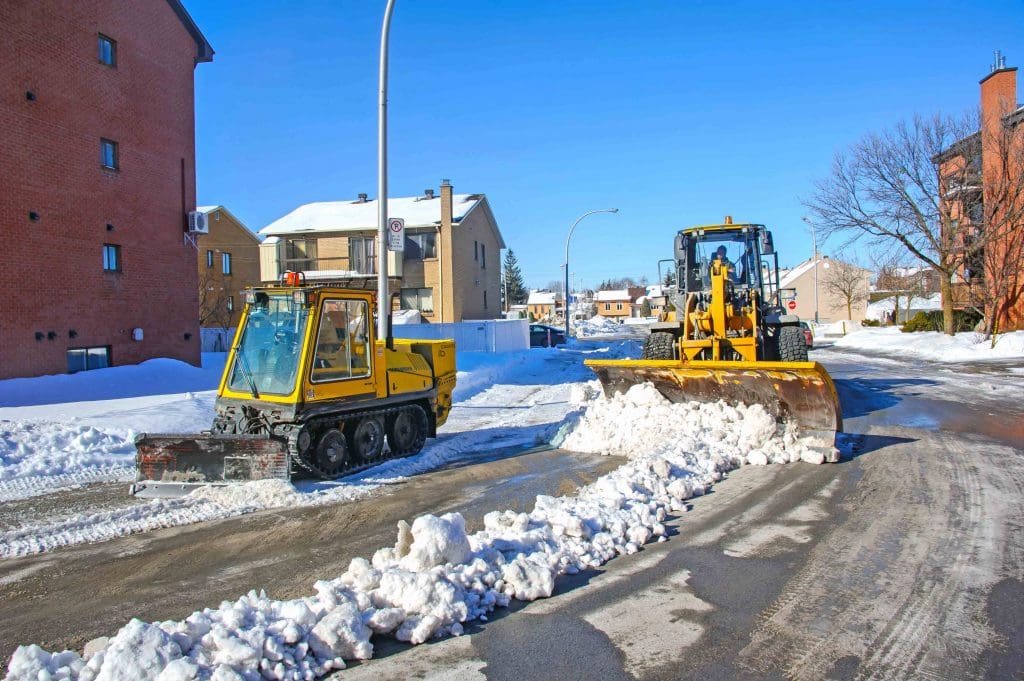
To ensure snow removal across its vast territory, Laval says it relies on a fleet of 740 vehicles and over 500 people working around the clock. The city also contracts out work with private companies under agreements totaling $20 million.
In total, municipal teams and their partners maintain operations on over 3,200 kilometers of streets and 1,300 kilometers of sidewalks – the distance between Laval and Vancouver – contributing to what the city maintains is safe and accessible travel along its roads and streets during the winter season.
Parti Laval critical of new approach
Not long after the City of Laval’s executive committee announced the new snow removal measures, members of the official opposition denounced what they said will be service reductions likely to be felt by Laval residents as early as this winter.
Among the difficulties the Parti Laval claims Laval residents could expect in the coming months are longer sidewalk clearing times, up to 50 per cent more time before the first snow removal on some residential streets, and reduced salt applications on roads and icy sidewalks.
“If Laval residents already felt things were tough last winter, this new policy shouldn’t reassure them,” says Louise Lortie, interim leader of the Laval Party. “More snow before they intervene, more time to do the job: this isn’t an improvement in service – it’s a lowering of municipal standards.”
The party, which currently has the status of being the official opposition on city council, says the city’s new policy fails to address another more fundamental problem – safety and traffic flow.
“We are learning that during severe storms, some residential sidewalks will only be plowed on one side and could even be temporarily closed,” says Lortie. “Students will be forced to walk in the middle of the street to get to school, and we should expect bus stops to be inaccessible.
‘Dynamic parking’ system criticized
The opposition cites the city’s dynamic parking project as an example of poor snow removal management. The Parti Laval maintains that residents are now forced to constantly monitor parking signs and move their vehicles according to restrictions in order to avoid being ticketed.
This year, in the sectors where this system has been implemented, according to the party, nearly 2,000 parking tickets were issued between April and August, long before winter operations began.
According to statistics from the Public Works Department, obtained by the Parti Laval and shared with The Laval News, the number of tickets issued increased by approximately 70 per cent in two years, rising from around 3,000 to over 5,000, with nearly two-thirds of these in sectors 2 and 3, where dynamic parking is now in place.