Boyer defends ‘big projects’ like Place Bell, as city records $11.3 million deficit
In the aftermath of a 46-car freight train derailment in July in Repentigny that forced the evacuation of more than 200 residents, Action Laval tried without success during the August 11 Laval city council meeting to initiate a debate on a motion demanding that a thorough inspection of railway lines be carried out in Laval immediately.
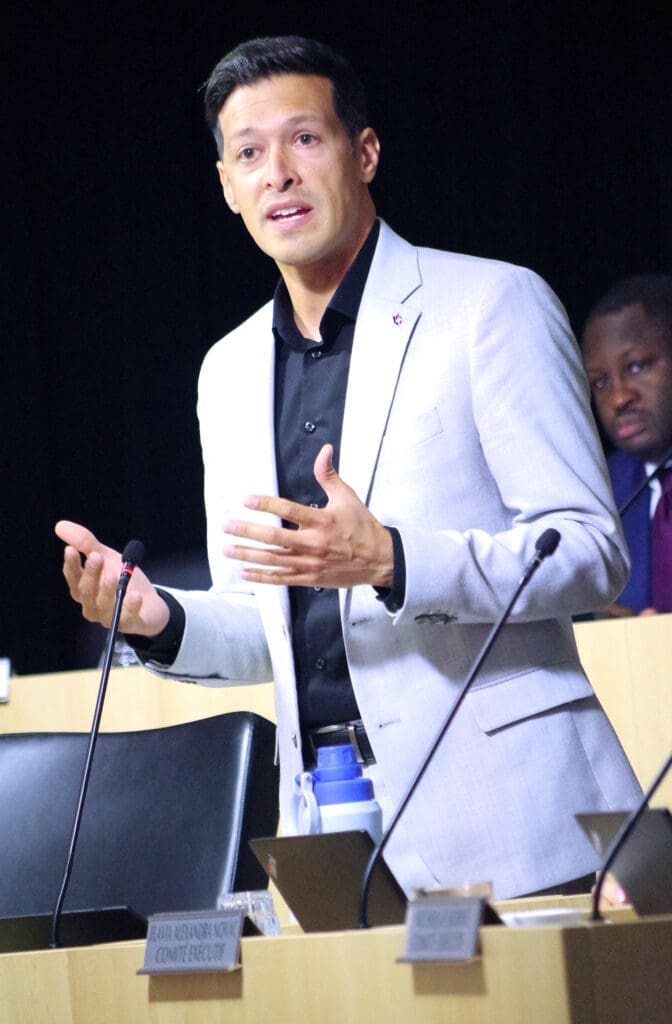
The proposal, tabled by Action Laval city councillor for Saint-Bruno David De Cotis, called for a full inspection of the railway infrastructure used for freight transport within Laval.
Demanding an inspection
In the proposal, the opposition party requested that the city formally contact the CPKC railroad as well as the Quebec-Gatineau Railway (CFQG) to conduct a thorough inspection of their tracks, ties and switches and submit a detailed report to the city.
The request was a direct result of the derailment of the railcars on July 5 in Repentigny, where the Transportation Safety Board of Canada ended up identifying major anomalies, including misaligned ties and missing anti-rail guards.
In a statement issued by Transport Canada a few days after the derailment, the federal agency responsible for the Transportation Safety Board of Canada said it understood “the concern and disruption this incident has caused for the Repentigny community and understand the importance of restoring confidence that the railway is operating safely.”
Laval train derailment in 2017
“Two railway lines run through Laval, passing by residential neighbourhoods, parks and even daycare centres,” De Cotis said in a statement issued by Action Laval. “After what happened in Repentigny, it is completely irresponsible not to immediately demand a preventative inspection of our infrastructure.”
The incident in Repentigny was a reminder of a train derailment that took place in Laval in October 2017. In that case, around a half-dozen out of total of 99 rail cars carrying an assortment of freight – including highly-volatile propane – left the rails after passing on a bridge going from Laval to Terrebonne over the Rivière des Mille Îles.
“Laval families deserve better than a city council that turns a blind eye to known risks,” said Action Laval leader Achille Cifelli. “Public safety should never be a partisan issue.”

Deficit criticized by opponents
When the City of Laval recently declared an $11.3 million operating deficit after filing its mid-year financial statement, it was only a matter of time before there was a reaction from the public.
During the August council meeting’s question period, Stéphane Chambon demanded answers from Mayor Stéphane Boyer. “Our net debt is now approaching $1.2 billion,” Chambon said.
“And in spite of this situation, it continues to progress year after year. Mister mayor: where is the limit? At what level of indebtedness will your administration finally decide to slow down, to prioritize and to make choices, because it’s not possible to do everything at the same time.
“Are you ready to present a real plan to control the debt with clear priorities and projects that could be postponed, three-dimensioned or abandoned?” Chambon added.
Big versus small projects
Before responding, Mayor Boyer said he was not surprised by Chambon’s line of questioning since Chambon is a member of Action Laval’s executive committee.
While noting that council’s opposition forces continue to insist the administration is still focused on large and costly projects, Boyer declared that his team has in fact been concentrating more attention lately on smaller and more local projects.

As an example, he cited the combination library/community centre and other projects built in recent years in Saint-François, the district overseen by Action Laval councillor Isabelle Piché. “Same thing for Mr. De Cotis – also a community centre, a dog park, the makeover of a synthetic sports field, a skatepark soon,” said Boyer.
“Investments in the districts, there are some everywhere,” he continued. “Unfortunately, the opposition positions itself as always against projects which are a bit larger. But for me, a larger project is not bad, taking the example of Place Bell.
One of Laval’s best assets, says Boyer
“Back then, Place Bell was being contested and it was being said it was too expensive, that it wasn’t worth it and that in Laval it was better to have just two or three district arenas,” said Boyer. “But today, I consider that Place Bell is one of the best assets the city has to make Laval known.
“We have more than a hundred shows there annually. We have the Rocket to stir people, we have the Victoire. When we go to Place Bell and experience an event in a large group, I think we can feel proud of our city. We need both, yes. We need large projects because we are a large city – the third largest city in Quebec – and smaller projects in the districts which is what we are doing.”