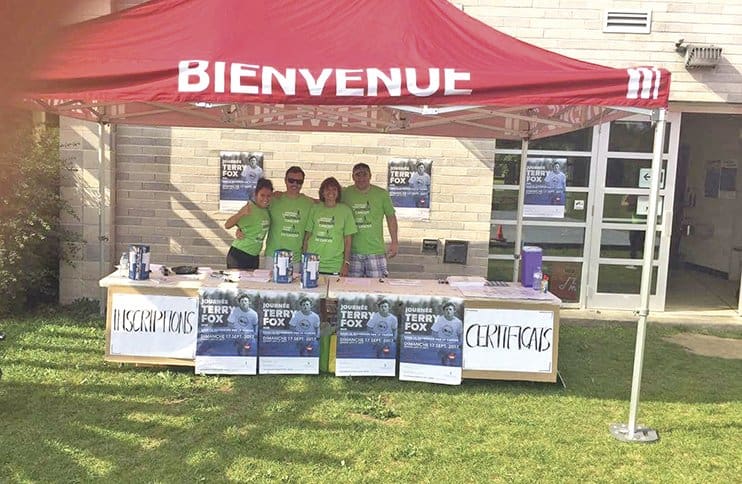
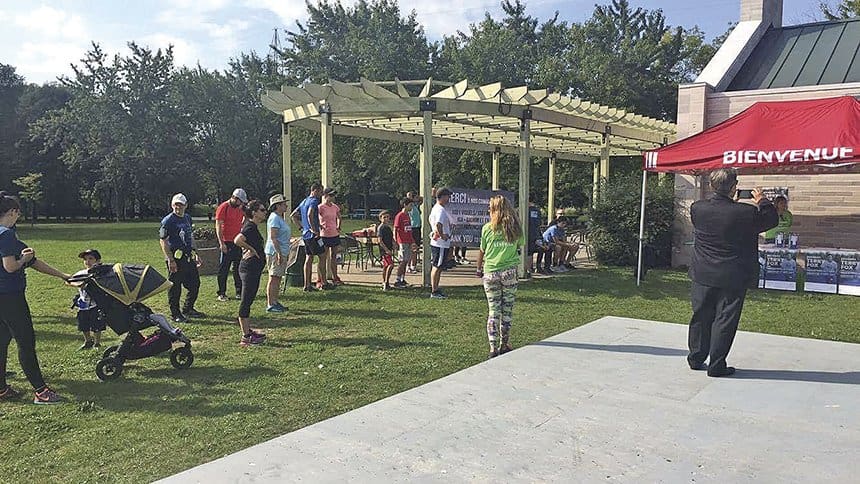
(TLN) The first Terry Fox Run to take place in Laval in more than a dozen years “was a success,” says Jeffrey Marshall, who led efforts to organize the event held at Parc des Prairies on Sept. 17.
Pleased with results
“With over 40 participants and over $5,000 raised for the Terry Fox Foundation, I am very happy with the results,” Marshall told the Laval News.
He said he wanted to thank the event’s sponsors, including Laval-des-Rapides MNA Saul Polo, Vimy MP Eva Nassif, and the City of Laval, as well as the many volunteers without whom the return of the Terry Fox Run to Laval would not have been possible.
Run participants prepare to get out on the circuit for the Laval Terry Fox Run held at Parc des Prairies on Sept. 17.
Sponsors and volunteers
“I would also like to thank all the participants for helping to make Terry’s dream a reality,” said Marshall. “As I have committed to organizing the event next year, I am confident that it will be a huge success. I hope to see you there.”
People from Laval and from all over walked or ran at the family oriented non-competitive Laval Terry Fox Run to raise funds for cancer research. While many schools in Laval hold Terry Fox Runs for their students, this was the first regional Terry Fox Run to be held in Laval since 2004.
Preparing for next year
Participants raised money online at terryfoxrun.org, by gathering pledges from family and friends, or by submitting a donation on the day of the run. The efforts of Terry Fox Run participants yield incredible results. Since 1999, the Terry Fox Foundation has financed over $50 million dollars for cancer research projects in Quebec.
Those still wishing to contribute donations or who would like to help organize next year’s Laval Terry Fox Run can contact the Quebec organizers by email at qc@terryfoxrun.org, or by calling 1-888-836-9786. For more information, visit terryfox.org.
(TLN) The Société de transport de Laval’s No. 360 bus line serving downtown Laval proved to be highly successful over the past summer when nearly 24,000 passengers used it between June 24 and Aug. 25, according to STL officials.
360 ridership up
They say use rose 198 per cent compared to 2016 when the STL was charging a regular fare for taking the 360. This past summer, the bus was free of charge. The transit agency says the line has transported a total of 35,000 passengers since it started last year, and up to 40,000 are expected to use the line by the end of 2017.
The 360 is a collaborative project put together by the STL, the City of Laval, Tourisme Laval, the Centropolis, the Cosmodôme, the Carrefour Laval, the Centre Laval and a number of tourist attractions in and around Laval’s central area, including SkyVenture, Putting Edge, Escalade Clip ‘n Climb and Maeva Surf.
A successful bus
While the line operates every day during the summer, the frequency of buses depends on the time of year, although it runs more often on school holidays as well as on weekends throughout the year. It leaves on its route every 25 minutes, starting from the Montmorency Metro station.
“The creation of the 360 line is an example of daring, of cooperation and partnership between several players in the region,” Mayor Marc Demers says. “Laval is one of the few cities in Quebec to offer this type of transportation free in its downtown area. This service is right in line with our determination to encourage urban transit and active transport.”
Transit innovation, says STL head
“The availability of this free route dedicated for touristic purposes is, without any doubt, an innovation for an urban transit company,” said STL president David De Cotis. “The STL has an exceptional track record when it comes to innovation and is constantly looking to improve its service. Offering the 360 line for free is the manifestation of our strategic planning for tourism, placing emphasis on welcoming tourists while encouraging fluidity, rapidity and ease of getting around.”
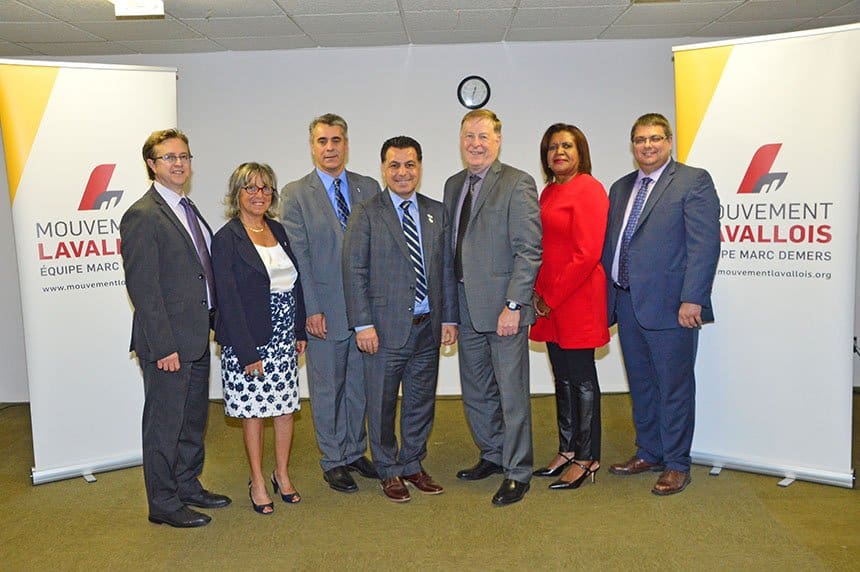
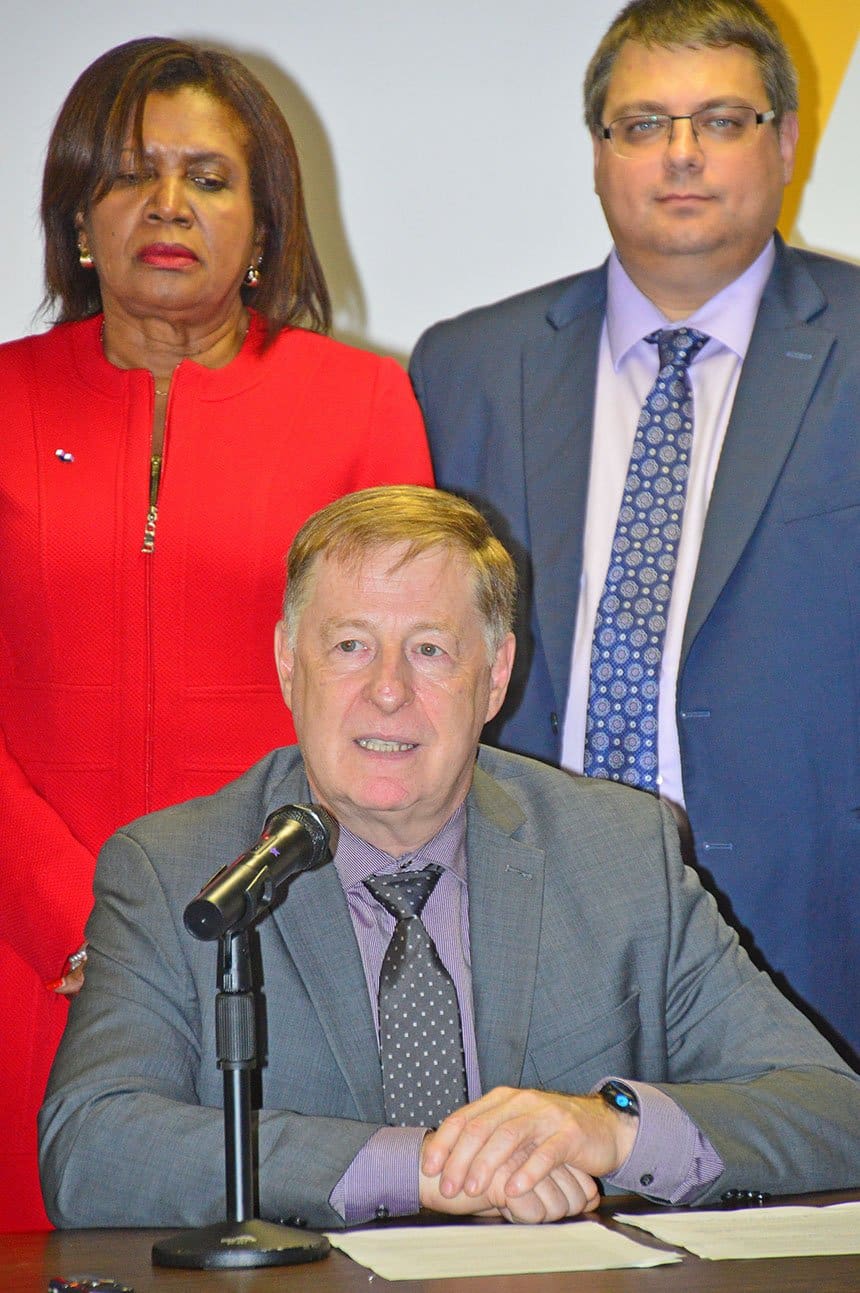
The Mouvement Lavallois is running on its record of sound financial management, while promising to pursue reforms started four years ago when they were first elected, says incumbent mayor Marc Demers.
Continuing the work
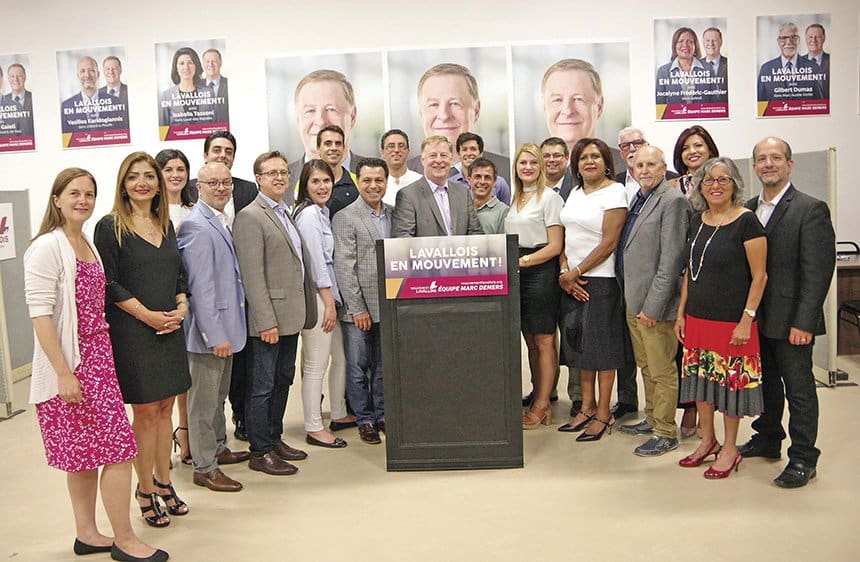
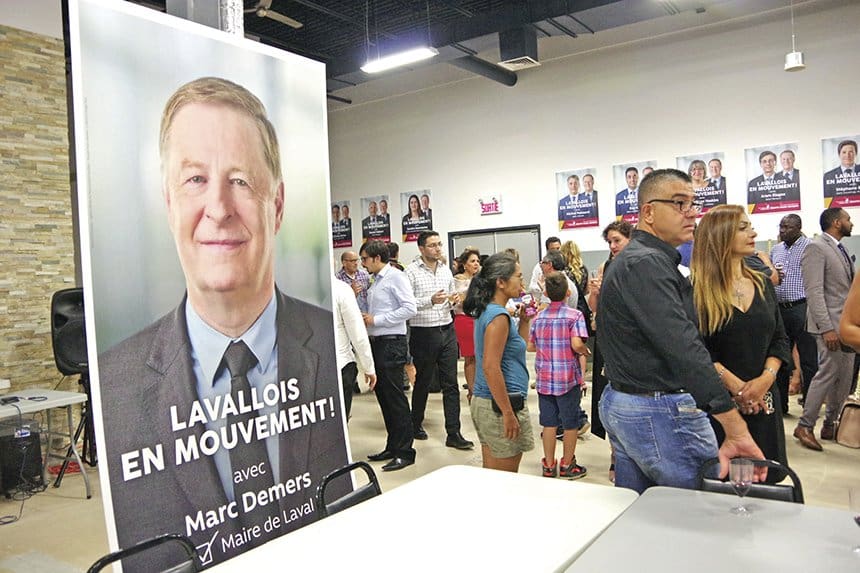
“We have to continue the work we have started in many different areas,” Demers said in an interview with the Laval News at the opening of the party’s campaign headquarters on l’Avenir Blvd. on Sept. 15, which was attended by up to 100 volunteers.
Among the started projects he included the future aquatic centre, the renovation of Laval’s arenas and parks, as well as planned strategies for all the region’s roads, and to bring infrastructures in general up to standard.
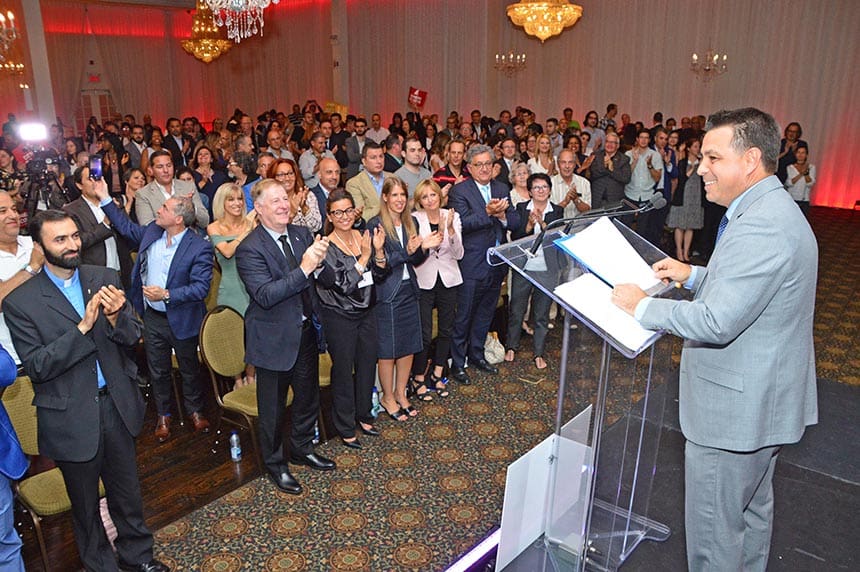
The Mouvement Lavallois held a special gathering and campaign headquarters opening for its volunteers on Sept. 15 on l’Avenir Blvd.
An economic strategy
“This is all to ensure the good financial health of the city, to give us a good credit rating so that the businesses and companies here can prosper and we are able to maintain our economic strategy as put into place,” he said, adding that a broader outline will be the party’s platform to be released shortly.
“We have demonstrated sound financial management,” he continued, noting that the city won a number of awards from the École nationale d’administration publique for Laval’s municipal policies, as well as a Canadian national recognition for city management.
A top credit rating
“We have the best credit in Quebec. We must maintain this balance and put Laval on a footing that emphasizes the economic as much as the social, cultural and environmental. Our master urban plan that we recently tabled is a major accomplishment. We also want to modify the City of Laval’s charter. These are all projects that need to be completed.”
Demers said the ML plans to make important announcements each week leading towards the Nov. 5 election day. “That’s our strategy,” he said. “We’ll be holding press conferences to announce our electoral commitments, each week a different subject.” He said there are campaign pledges coming “that I think people will like. At least we hope so.”
Keeping the momentum
Laval’s deputy mayor, David De Cotis, who is the ML’s founder, said he hasn’t lost any of the momentum that was set in motion when he launched his own campaign with a major gathering of supporters in late August.
“This is a continuation,” De Cotis said. “The momentum started there. Our slogan is Lavallois en mouvement and we’re still moving towards a greener and healthier city with its economy and better public transportation. Mayor Marc Demers as the leader of the Mouvement Lavallois did an excellent job over the past four years. The movement continues and we’re very proud of our accomplishments.”
(TLN) The City of Laval has announced that it has purchased the Guimond Sports Complex on Autoroute 440 for $14 million in order to answer an increasing demand by Laval residents for sports facilities.
The city says the purchase should put an end to problems experienced by residents with the availability of ice time at skating and hockey rinks in Laval in 2017-2018.
Steps taken to buy
“We are pleased to be able to add the Guimond Sports Complex to our current sports infrastructures,” said Mayor Marc Demers. “This recent and multipurpose arena will add to what the city is already offering to citizens for the practice of ice sports.”
In June, Laval placed a two-year reserve on the building, which belongs to the Guimond family, so as to show that the city had the intention of acquiring it and would be taking measures to do so. This was followed by an agreement in principle aimed at buying the building, which was formalized during the July 19 city council meeting.
Deal concluded
A signing of the act of sale took place recently at Laval city hall and took effect immediately. The sale includes the building as well as all equipment related to the facility’s purpose. Built in 2010, the Guimond Sports Complex has a regulation size skating rink, as well as two smaller training rinks.
“I am especially happy that the transaction closed to the satisfaction of both parties,” said the building’s seller Éric Guimond. According to the city, the building will continue to be used for the purpose it was originally designed for and will also continue serving as a principal base for the activities of local sports associations such as Hockey Laval which stages its programs there.
Acquisition of river bank lot in Saint-Vincent-de-Paul
Laval’s executive committee has authorized the evaluation service to initiate the appropriate measures requisite to acquiring a river front parcel of land that does not have a registered property title. This land, now known as the Berge de la Brise, is located along the river bed of the Rivière des Prairies, bordering Lévesque Boulevard East, near the intersection of Limoges Street. The property which lacks a cadastral title is a lot of approximately 2,500 square meters. The property has been renovated during the past few years and thirteen parking spaces have been built along the riverbank with a boat launch, a wharf and a picnic area.
CISSSL to receive grant to celebrate the 10th Annual Tree Day
The members of the executive committee have agreed to award a $ 10,000 grant to the Laval Integrated Center for Health and Social Services (CISSSL) as part of the celebration of the 10th annual Tree Day. The amount awarded will contribute to the planting of 186 trees. This horticultural embellishment is scheduled for September 27th and will involve the addition of about 100 new trees as well as the replacement of 86 ash trees affected by the Emerald Ash Borer beetle. The emerald ash borer was first detected in North America about fifteen years ago. Native to Asia, the beetle has proven to be highly destructive in North America as it is estimated to have caused the destruction of tens of millions of ash trees, causing considerable economic and ecological impacts.
It is hoped that these efforts will help raise public awareness of the importance of reducing urban heat islands as well as the contribution of natural foliage in maintaining good air quality. Held annually since 2008, this program has enabled more than 1,640 trees to be planted embellishing the landscapes of the CISSSL establishments.
Rental space for community organizations at Place des Aînés
One of the ways the municipal administration helps and supports accredited nonprofit community, recreational and sport association operating in Laval is by providing them access to permanent office spaces as well halls and gymnasiums in order to host their activities. However the requests from community organizations have increased and the quantities of locals available in municipal buildings and rental spaces are now insufficient to meet these demands.
Laval’s executive committee has agreed to rent space at the Place des Aînés for the use of organizations offering cultural and leisure activities. The budget that was approved for the year 2017 is up to a maximum of $ 24,000 (tax-free).
Grants totaling $ 13,200 to cultural recreation organizations
The Choeur Chanterelle du Collège Lava (Laval College Choir), Choeur Sainte-Dorothée (Sainte-Dorothée Choir), Ensemble vocal Universalis (Universal Vocal Ensemble), Quartier des arts du Cheval blanc (White Horse Arts Quarter) et Théâtre d’art lyrique de Laval (Laval Opera Theater) were awarded municipal grants totaling $13,200. In order to promote cultural development the management has invited cultural and leisure organizations to apply to the City of Laval for annual financial support for their activities. This assistance is funded and directed according to Laval’s Cultural Policy. The administration has committed resources and aide to support artistic, musical and cultural development whose fruit will help define Laval’s artistic community and cultivate an open, vibrant regional cultural identity.
Municipal Arenas Program
The Executive Committee adopted the Municipal Arenas Program and its budget for 2017-2018. The anticipated operating costs are $ 5,755,800. With the opening of the Bell Centers the municipal inventory has added two community ice rinks, the Olympic ice and the training ice (NHL) which will all be accessible to Laval youth. As a result, an additional 3,000 hours of ice time can now be offered residents and sports association alike, this is especially significant during the peak periods of use.
In addition, the acquisition of the Complexe sportif Guimond, the City of Laval has signed an agreement in principle, will lay to rest any uncertainty about the availability of this quality infrastructure for ice rink related activities as access to its regular ice rink and two small skating rinks, training areas and complementary services has been assured. This is especially important as the Hartland-Monahan arena remains closed till March 2018 as the renovation program continues on schedule. The renovations began in April 2017.
The municipal arena program addresses and describes policies governing the management of ice rinks facilities in Laval. It defines the opening schedules and operating hours of municipal arenas during the fall-winter period and in spring and summer. It provides the procedural guidelines for the distribution of the skating rink hours allocated to youth activities and to the population at large in the form of free skating time. It outlines the responsibilities in the collaborative management scheme for the operation of the program between the various municipal services, namely the Department of Culture, Recreation, Sport and Social Development and the Department of Building Management. The program directives also address supplementary service offers including the arena pro shops, food services and the obligatory presence of automated external defibrillators (AED). Key to the program’s success is the inclusion of directives that govern among other things policies to provide free activities to the population organized by the municipality and activities supervised by Laval organizations and partners.
Management of Indoor Swimming Pools facilities 2017-2018
The Executive Committee adopted the indoor swimming pools management program for 2017-2018. In terms of aquatic activities, the City of Laval organized its indoor pool scheduling with the view of offering the majority of Laval residents access to swimming pool hours. Citizens can participate in free swim, take swim lessons or participate in sport activities offered by the various clubs (swimming, diving, synchronized swimming, water polo or triathlon). The organization and operations of the various programs and authorized activities are supported by the leisure organizations, the sports clubs and the Mouvement aquatique de Laval according to the number of hours allocated to them. The program runs from September 5, 2017 to June 15, 2018.
New Service to pick up refrigerating appliances
In the context of its Greenhouse Gas Emission Reduction Plan, the City of Laval is now offering a free refrigerating appliance collection service in order to optimally collect and properly dispose of chlorofluorocarbons/halocarbons (CFCs and Freon) contained in the insulation foaming and cooling liquids of these units. An added ecological benefit is that this will also allow for the recycling and repurposing of various parts and materials with which these units are built.
The admissible appliances for pick up include; refrigerators, freezers, wine cellars, electric coolers, air conditioners, dehumidifiers, coolers, heat pumps and compressors.
A simple phone call to 311 to describe the item for recycling and to leave your coordinated is all that is needed to organize a pickup time. An agent from the Environment Service will schedule the service and contact residents with necessary directions.
Refrigerating appliances cannot be picked up during regular household waste collection. Leaving these appliances at the curb to be salvage by scrap collectors is not an ecological processing solution. It should be noted that the provincial regulation respecting halocarbons specifies that “Every person or municipality that, in connection with a residual materials collection service, picks up a refrigeration or air conditioning unit must, before disposing of the unit for elimination, recover or have the halocarbon contained in the cooling system of the unit recovered using the appropriate equipment and have it confined within a container designed for that purpose.” The City of Laval goes even farther by ensuring that insulation foaming, which also contains halocarbons is also processed adequately.
While almost everyone is aware of the scientific assertion that the release of halocarbons into the atmosphere contributes to the depletion of the ozone layer and climate change what is not common knowledge is that the effects of cooling agents used in refrigerating equipment represent a risk 5000 times more serious than CO2 in terms of global warming potential. Therefore, the ecological processing of 500 refrigeration appliances is equivalent to taking 300 cars off the road for a year.
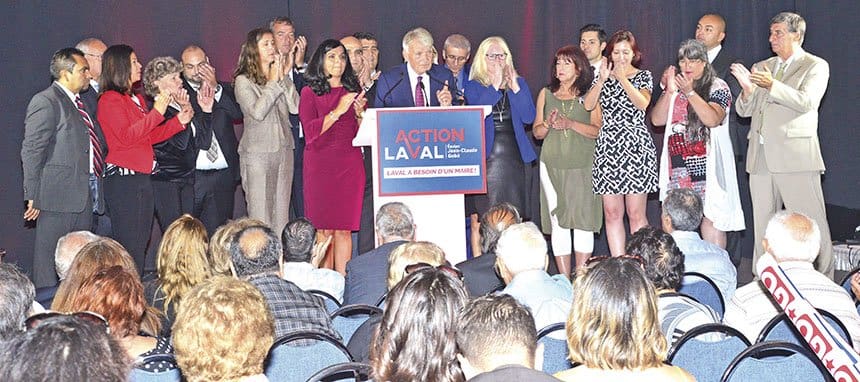
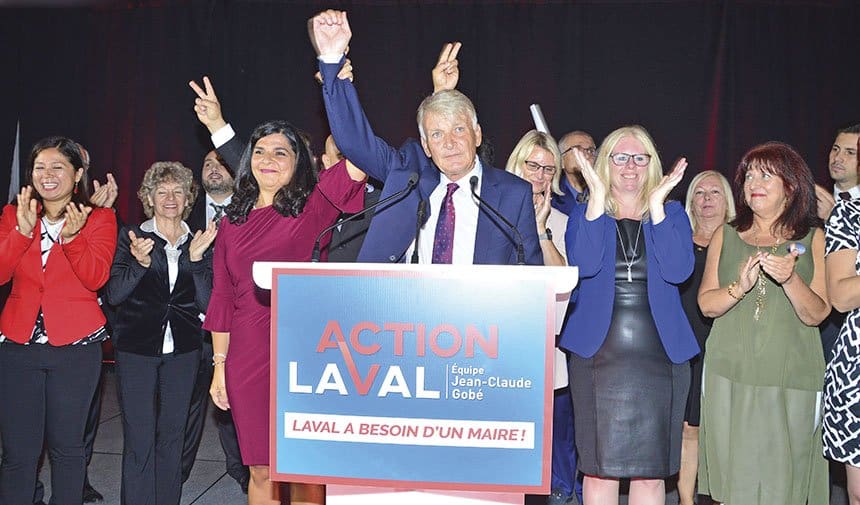
Action Laval mayoral candidate Jean-Claude Gobé announced during the party’s official campaign launch last Sunday that Canadian Olympic track and field athlete Nicolas Macrozonaris will be seeking the Sainte-Dorothée city council seat for Action Laval in City of Laval elections on Nov. 5.
Gobé attacks Demers
Around 500 Action Laval supporters who gathered at the Palace convention centre for the official opposition municipal party’s first major event listened as Gobé, a former Quebec MNA who ran unsuccessfully for mayor in the 2013 election, derided incumbent mayor and Mouvement Lavallois leader Marc Demers.
Gobé tore into Demers for allegedly allowing the City of Laval’s influence with other cities and the provincial government to decline, while also allowing decisions affecting Laval to be made without any input by the city.
“Laval is the third most important city in Quebec and it is time that it gets back in the spot where it belongs,” said Gobé. “It’s time to put Laval back on the map. I will make sure that all decisions made at the other levels, using my experience, are taken in the best interests of Laval residents. Laval needs a mayor and I am ready.”
Action Laval hopes to form the next administration at Laval city hall following the Nov. 5 municipal elections.
Former Olympian running
Gobé, who is himself quite a sports and fitness buff, introduced Macrozonaris, who still ranks as Canada’s third-fastest 100-metre sprinter, as a future city councillor who would be made responsible for promoting sports and physical fitness in a municipal administration led by Gobé as mayor.
“We must encourage discipline and participation in sports by youth in Laval,” Macrozonaris said in a statement. “Several means are at our disposal to get our young to be more active. By joining Action Laval, I hope to use the means at the disposal of the City of Laval to improve sports services in the districts, for the young as well as those who are less young.”
Youth and sports
For his part, Gobé said the Action Laval platform “contains all the elements to which Mr. Macrozonaris makes reference. It is completely incomprehensible that youths and parents in Laval must take their children to Montreal for hockey practice because Laval’s infrastructures are inadequate, insufficient and too centralized. We are going to take action with regard to this aspect and add to what is already being offered in neighbourhoods neglected by the Demers administration.”
Gobé contended that Mayor Demers “neglected the citizens of Laval over the recent past years at city hall. During the course of our talks with residents, they said time and again that never have they felt so distant from their local elected officials. There has to be a change of attitude at Laval city hall. The elected officials should be at the service of the citizens, and not the other way around. To the citizens I will be a mayor who is close to you and truly listening to your needs. The same will be true of my team.”
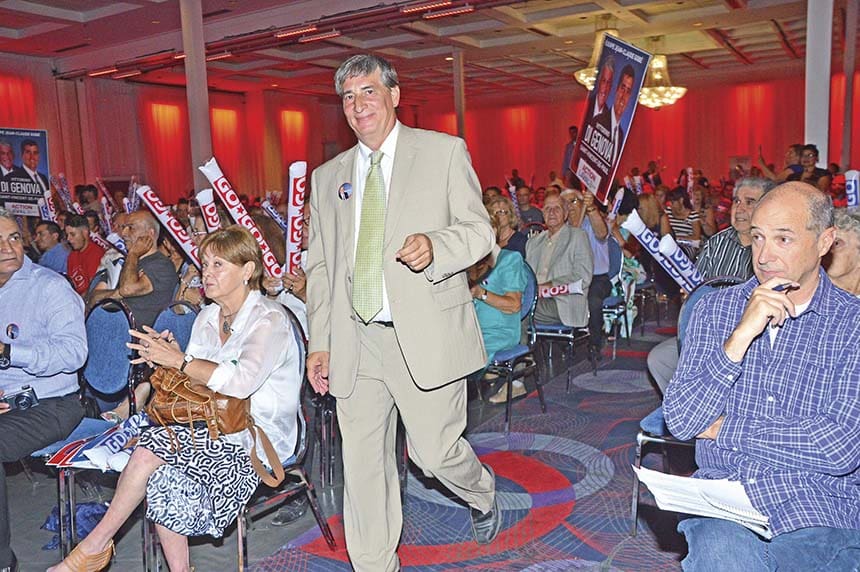
Action Laval candidate in Fabreville Robert Bordeleau makes his way towards the stage during the party’s campaign launch at the Palace convention last Sunday.
Voters disappointed, said Gobé
Gobé said that many residents of Laval he’d spoken to recently were disappointed with the direction the City of Laval took under the Demers administration. “These were people who had been expecting a new era to begin and they didn’t get that with the current administration. On the contrary, we got a 6.5 per cent increase in municipal taxes in three years.”
He repeated a commitment first made by Action Laval the week before to cut property taxes by 3 per cent. It would be paid for with money from the $10 million Place-du-Souvenir Fund, which was created by the Demers administration from money reclaimed by the city from former mayor Gilles Vaillancourt following Vaillancourt’s conviction on corruption and misappropriation charges.
This issue covers local events such us politics, sports and human interest stories. It features editorials and other columns. Click on the image to read the paper.
Comparing Action Laval leader Jean-Claude Gobé’s recent pledge to reduce property taxes by 3 per cent with U.S. president Donald Trump’s habit of distorting facts, Laval mayor Marc Demers is dismissing Gobé’s campaign promise as a short-sighted attempt to win votes in the Nov. 5 municipal election.
ML incumbents are back
Demers made the comparison last week during a press conference held by his party, the incumbent Mouvement Lavallois, to announce candidates in eastern Laval districts.
While ML incumbents are running again in Saint-Vincent-de-Paul (Paolo Galati), Val-des-Arbres (Christiane Yoakim), Duvernay-Pont Viau (Stéphane Boyer), Vimont (Michel Poissant), Saint-Bruno (David De Cotis) and Auteuil (Jocelyne Frédéric-Gauthier), a newcomer, Éric Morasse, is running for the ML in Saint-François.
Gobé pledged 3 per cent cut
While announcing Action Laval’s campaign promises last week, Gobé stated that Demers “has raised taxes by 6.5 per cent over the past few years. Laval residents are out of breath. I am announcing a 3.0 per cent decrease in property taxes in the first budget of my term as mayor of Laval.”
At the ML’s press conference the following day, Demers reacted this way. “He (Gobé) didn’t mention anything about the impact of doing so, so he’s buying a car without knowing what the price is. So I don’t think it’s possible. And if he ever gets elected, I don’t think it will be possible. And if it is it’s going to be at the cost of many, many sacrifices.
Keeping balanced, says Demers
“One thing you have to keep in mind,” Demers continued, “is to keep the proper balance between your finances, obligations and things you have to pay. Otherwise Standard & Poors will not give you a good credit rating. And if you don’t have a good credit rating the interest will go up. The City of Laval has long-term debt on which we don’t want the interest rate to go up.”
Regarding Gobé’s claim the ML raised taxes 6.5 per cent, Demers acknowledged it, but pointed out that the increase was spread over four years. He said the average over that period actually comes out to 1.62 per cent, “which is lower than any major city in Quebec.”
Incumbent Laval mayor Marc Demers maintains that the average property tax increase for residences over the past four years was 1.62 per cent, and not 6.5 per cent as claimed by Action Laval leader Jean-Claude Gobé.
Marked increase one year
Demers noted that the City of Montreal raised its property taxes an average 2 per cent, not including local increases by the boroughs. But he also admitted that during one exceptional year during the ML’s term, the ML administration took the extraordinary measure of raising property taxes by 3.2 per cent because the Quebec government had stopped payment of a multimillion dollar subsidy while retaliating in a dispute with Laval.
“And one other thing,” added Demers. “In 2013 – it wasn’t because of us – but the residential taxes were frozen. So in 2014 the taxes were frozen, and that had consequences. So that was two years in a row. It was not our doing in 2013, but we have to live with the consequences.”
Residential taxes frozen
According to the city’s budget for 2013, most single-family home owners in Laval were not called upon to pay higher taxes for the following year, although other residential property owners would see increases at around the prevailing two per cent rate of inflation.
In the 2013 budget which was tabled by newly-installed mayor Alexandre Duplessis following the departure of former mayor Gilles Vaillancourt, nearly 55 per cent of residential property owners would see their taxes frozen or reduced.
More than 700 devoted followers of the Mouvement Lavallois turned out at the Embassy Plaza on Aug. 28 to help launch the 2017 election campaign of the man credited as the party’s founder – David De Cotis.
While a Laval-area Liberal MNA came out recently to support another municipal party’s mayoralty candidate, De Cotis (who is Laval’s executive-committee vice-president as well as the councillor for Saint-Bruno) has the backing of Vimont Liberal MNA Jean Rousselle.
MNA supports De Cotis
“I am here this evening because there are lots of people who are going to say ‘You’re taking sides,’” Rousselle said. “Yes I am taking sides. I will normally not get involved in municipal politics – except this evening. Why? Because I am with David De Cotis and I will explain to you why. I am doing this not as an MNA but personally.”
Rousselle recounted knowing De Cotis since the summer of 2007, which was two years before the 2009 Laval city election. “It’s a guy who takes to heart what he does,” he said. “What he does he does from the heart and he does it for the people.”
Incumbent mayor Marc Demers said he had “always been impressed by David De Cotis, but his capacity to bring people together is phenomenal and we see the proof of it here this evening. It’s not easy for a politician to draw and bring people together for such a large gathering.” According to Demers, De Cotis talked him into becoming the ML’s 2013 mayoralty candidate.
Mouvement Lavallois founder David De Cotis, right, gets a standing ovation during the launch of his campaign to be re-elected city councillor for the district of Saint-Bruno.
Praise from the mayor
“He was one of the first citizens to stand up and say enough is enough, things have to change,” he added regarding De Cotis’s first attempts as far back as 2007 to dethrone Laval’s long-reigning former mayor Gilles Vaillancourt. “He had the courage and the persistence to denounce the practices during that era. He fought against the established power. You must remember that it wasn’t easy at the time.”
Demers compared the financial standings of the ML to Vaillancourt’s Parti PRO back then, which were $9,000 for the former and $1.2 million for the latter respectively (not including what the Parti PRO was hiding elsewhere.) “If you have a difficult mission and you’re not sure you can win, the person you want on your team is David,” said Demers.
“David is someone courageous and determined. Laval owes him a lot. Those who know him are not surprised. David is a hard worker. He doesn’t count his hours. David is someone filled with passion who devotes all his energy to his political commitment – which is rare. He isn’t in politics for power or prestige. If that were the case he wouldn’t have spent years fighting against the most powerful mayor of the era.”
Mayor Marc Demers and Laval executive-committee vice-president David De Cotis, who is running for re-election in Saint-Bruno.
Loving wife’s support
De Cotis’s wife, Isabelle Piché, who assisted her husband during the Mouvement Lavallois’s early days, maintained that the party’s name was inspired by a TV commercial for a major Canadian retail chain. “But I can tell you it hasn’t been easy being the wife of the leader of a new political party,” she said, noting she spent many an evening dining alone while her husband was busy assisting the party.
Lise Lalande, executive-director of the Société Alzheimer Laval, said De Cotis, the councillor for the district of Saint-Bruno who is also vice-president of Laval’s executive-committee, responded immediately when the Société Alzheimer asked for help nearly four years ago.
“David is a person of action and is very devoted, generous and transparent,” she said. “As a municipal councillor, he also likes to improve life in his district, while creating opportunities to bring people together in the community.”
De Cotis’s wife, Isabelle Piché, spoke of the sacrifices involved in being the spouse of a leader in a political party.
Alzheimer Society
As an example, she referred to De Cotis’s creation of the Fête de Quartier de Saint-Bruno, from which the proceeds have been donated annually over the past few years to the Société Alzheimer. “On behalf of all those we help, we thank David for his commitment, which also attests to his compassion,” she said. “Thank you David for helping us to spread hope and the Société Alzheimer supports your candidacy.”
For his own part, De Cotis said that when he looks back on the first days of the Mouvement Lavallois, “it started from nothing but has gone far. I see Laval as a city that is developing in the present, but also in context to the future.” He said he was inviting the population of Laval to give the ML another mandate so that it can pursue the work started in 2013.
(TLN) On Sept. 5, Laval city council adopted By-law L-12519, concerning rights to housing. According to the city, this new legal tool will henceforth be protecting tenants as well as landlords in Laval from circumstances impeding access to safe and secure dwellings.
The new housing code will allow the City of Laval to intervene and demand renovations or repairs in cases where a dwelling, without necessarily being unsanitary, needs work on things such as broken windows, no hot water, inadequate heating, etc. The coming into effect of the regulations is set for March 1, 2018 so that various municipal services can prepare to enforce it.
Long overdue, says mayor
“The housing code was long awaited by citizens and organizations who concern themselves with housing,” says Mayor Marc Demers. “This tool will allow us in a more proactive way to intervene in order to allow all residents to live in housing that is safe and secure.”
The new code will make it possible to do the following things: forbid landlords or tenants to do anything that causes sanitation problems, such as allowing mould to take hold, or not doing anything about pests such as cockroaches or other parasitical insects; establish rules making it mandatory to declare when there are or have been bedbugs in a dwelling. There are other measures, as well.