Home Blog Page 120

Revelakis accuses Boyer and Mouvement lavallois of partisan practices

CCU should include all parties, says Action Laval councillor for Chomedey

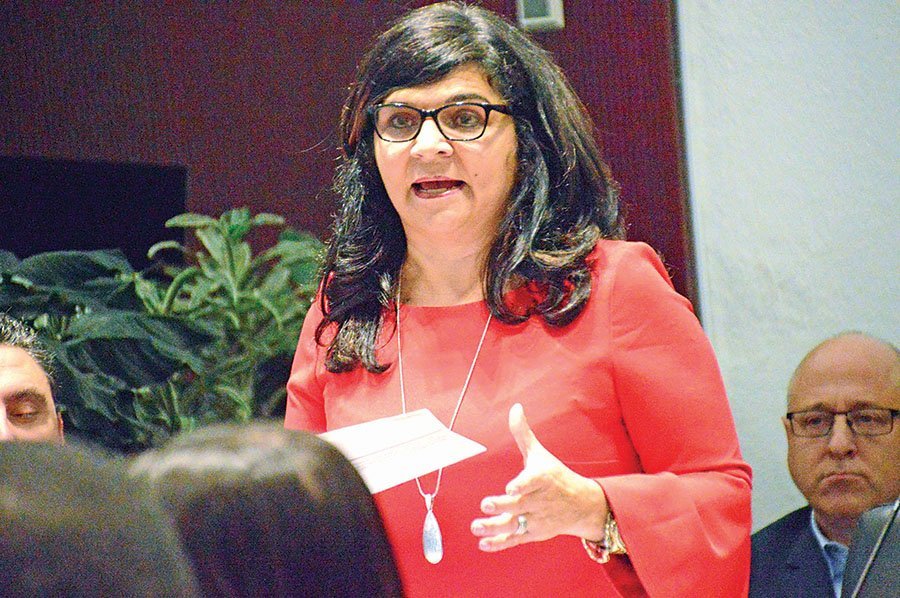
Action Laval city councillor for Chomedey Aglaia Revelakis is accusing Mayor Stéphane Boyer and his administration of partisan practices because of the mayor’s seeming preference for appointing people from his own ranks to the Consultative Committee on Urban Planning (CCU).

Wants it to be non-partisan

In a statement by Revelakis released by Action Laval on the same day as the Feb. 1 meeting of city council, she noted that during that meeting, she had tabled a motion calling for the CCU to be non-partisan and made up of city councillors from each of the municipal parties.

“Based on what you find in Quebec and in Ottawa, the fundamental principle with committees is that all the political options are represented in proportion to the number of elected officials in the National Assembly or the House of Commons,” Revelakis said.

‘No respect,’ says Revelakis

“This is meant to ensure that the largest number of opinions are heard, and not only those of the party in power,” she added. “This evening, the message from the mayor and his party was clear. There is only the opinion of those who voted for them that counts. He shows no respect whatever for institutions and democracy.”
City council passes Chomedey councillor’s Pontic Genocide resolution
Chomedey city councillor Aglaia Revelakis.

Noting that just a little more than 28 per cent of eligible Laval residents voted in the municipal elections last Nov. 7, she maintained that fewer than 12 per cent of those on the voters’ list actually voted for Mayor Boyer and his team. “He doesn’t have a strong mandate from the population of Laval,” she insisted.

‘System democratic,’ she says

“The mayor cannot make decisions without taking into consideration the opinions expressed,” Revelakis continued. “Our system is democratic. The mayor cannot appoint only those who share his ideas on a committee of this importance, while ignoring the other political options.”

The City of Laval’s Consultative Committee on Urban Planning is composed of four city councillors and four non-elected residents of Laval. The four city council members are:

Yannick Langlois (L’Orée-des-bois)President of the CCU
​Ray Khalil (Sainte-Dorothée)Elected member
​Pierre Brabant (Vimont)Elected member
Sandra El-Helou (Souvenir-Labelle)​Elected member

The four non-elected Laval residents who sit on the CCU are:

Johanne Couture​Resident​
​​Omar Waedh​​​Resident
​Serge Vaugeois​Resident
​Wassila Djaziri​Resident

Without identifying anyone specifically, Revelakis noted that one of the non-elected resident members of the CCU was a candidate in the Nov. 7 elections for one of the municipal parties.

In a news release issued last June 1 by the Mouvement lavallois, then-mayoralty candidate Stéphane Boyer announced that Omar Waedh would be running for the party in the district of Chomedey.

Sat on CCU before elections

A biography of Waedh included in the same release describes him as having an extensive background in engineering, with experience at leading projects throughout the Montreal region worth more than $100 million.

‘The mayor cannot appoint only those who share his ideas on a committee of this importance’

“Currently employed by Devimco real estate as a project director, he has among other things worked for Mondev construction, for Réseau sélection in Laval, for Cree Construction & Development in James Bay whose head office is in Laval and for Home Dépôt,” states the Mouvement lavallois. The release goes on to note that Waedh has been very active in his community, serving on the board of a non-profit organization that offers affordable housing for single mothers, and that he sat as a non-elected resident member of the CCU before last November’s municipal elections.


Anglos struggle to see where they stand with Quebec government

Raquel Fletcher in Quebec City

Despite the Coalition Avenir Québec (CAQ) government’s repeated insistence that it will maintain the rights of English-speaking Quebecers, anglophones are struggling to see where they stand with this government.

Recent decisions and statements by the premier have only heightened concerns.

Take, for instance, the decision to cancel the Dawson College expansion, a project the government itself chose to accelerate just last fall when it included it in an important infrastructure bill. Last week, the province reversed course and said it was going to prioritize francophone students over anglophone students.

#NewsMatters: The National Assembly Report

Or take an incident during question period last Thursday when the Blue Room erupted in cacophony amid heated exchanges and loud arguments between MNAs.

The trigger of this eruption was a joke made off camera and off microphone, but still loud enough to be heard by MNAs and journalists. When Liberal Leader Dominique Anglade misspoke, calling Paradis “Mr. Québécois” instead of “Mr. Speaker,” Premier François Legault retorted, “Of course, he’s a caquiste.”

Liberal MNAs interpreted this to mean either the premier was saying only people who vote for the CAQ were “true” Quebecers or people who vote Liberal were not. Either way, they said the premier’s “joke” was unacceptable.

When Liberal MNAs questioned the government about Dawson and other issues, including bilingual judges, Legault mocked the opposition, pronouncing the word “Liberal” in French with an English accent. He appeared to be insinuating the Quebec Liberal Party was more interested in defending English minority rights than the French language.

Legault denied his government is trying to sow division and refused Anglade’s demand for an apology.

Deliberate election strategy?

Despite Question Period rules that forbid heckling, chaotic exchanges between the government and opposition Liberals have often made headlines.

Last June, Legault apologized for his tone and promised to try harder to “control his temper.” In December, recognizing he hadn’t made much improvement, he told journalists he would drink more herbal tea and reiterated the promise not to let opposition parties get under his skin.

However, just three days into the new session, the National Assembly once again veered out of control. This time, though, there is a notable difference. The premier has often blamed his outbursts on the opposition, saying he rises to the occasion when provoked.

But it’s now the premier who seems to be the one doing the provoking. Commentators have begun to ask if this is a deliberate electoral strategy to appeal to nationalist voters ahead of this fall’s election.

Dividing Quebecers

While the Liberal Party accuses the premier of deliberately trying to divide Quebecers, the premier seemed to suggest during a recent press conference that Quebecers were already divided, along linguistic lines, when it comes to which political parties they vote for. According to the most recent Leger poll, the Liberals only have the support of 12 per cent of Quebec francophones. Most Liberal support appears to be concentrated in English Montreal.

“Mrs. Anglade is in a tough position to defend French,” Legault said. “I think her predecessors like Jean Lesage or Robert Bourassa were nationalists. I think we can do both: defend the French language and be open to all communities.”

Last week’s debate drew numerous commentaries in the province’s French media, with one opinion columnist insisting the premier should say he’s sorry.

“He should offer an apology, say that it was a bad joke,” wrote Antoine Robitaille in Le Journal de Québec. “And remember that anglophones are obviously full Quebecers; they should be treated as such.”

Can voters expect a debate preceding the election about whether anglophones consider themselves or are considered by others as “true” Quebecers? Things could get messy.

Maybe that’s why Liberal MNA David Birnbaum tried to steer debate about Dawson College away from language altogether. Birnbaum has often raised concerns of the anglophone community in the house and has not shied away from asking his questions in English.

“A norm is a norm, is a norm. There is no language involved,” Birnbaum said. “The buck stops with the premier. He made the choice to axe the Dawson project. He threw the needs of these Quebec students under the bus.” With Bill 96 currently being studied by the National Assembly, the language debate will not be going away anytime soon. The question is whether debate can stay civil.

That’s enough. Time to Shift Covid to an Endemic Phase

It’s time to lift Covid restrictions. Canadians are clearly fed up. We seem to have done everything asked of us and despite these efforts, variants will be with us, perhaps always. So, let’s do the best we can by first getting our shots, wearing masks in crowded indoor environments, and get on with our lives.

Because Covid-19 is so infectious and can not be eliminated entirely, more and more epidemiologists believe it’s best to treat it as a background endemic illness.

In British Columbia Dr. Bonnie Henry, a strong advocate of “aggressive lockdowns”, is now suggesting Covid-19 and its variants be treated more like the flu. The soft-spoken former naval officer, managed a respected take charge attitude that avoided the carnage that took place in senior homes in Quebec and Ontario. “We have to change our way of thinking, much like we manage other respiratory illnesses,” In other words, remain isolated until you feel better.

Toronto’s Medical Officer of Health Eileen de Villa said residents should be treating Covid more like influenza.

Canada’s Chief Public Health Officer Theresa Tam has changed her thinking, telling a House of Commons Health Committee, “herd immunity may not be achievable because the virus undergoes constant evolution.”

Alberta’s Jason Kenney says “After two years of this, we simply cannot continue…” European countries like Spain, France, Germany, Ireland and England, according to the National Post, “have seen their public health establishments signal a shift into the endemic phase.”

Germany’s Health Minister Karl Lauterbach, an epidemiologist, uses the word “correct” for Germans to return to a normal life as soon as Omicron cases start to show a downward curve.

Newsfirst columnist Robert Vairo.

Denmark is lifting most of its Covid restrictions because they no longer consider it a “critical threat.” Hospitalization in that European country is still high, but the number in ICU is decreasing. And that is with 80% of the population fully vaccinated, about the same as Canada.

One of the drawbacks is the pharmaceuticals, Pfizer and Moderna. They are reportedly producing 350 million doses per month, but focusing on selling expensive vaccines to wealthy countries only. This is not helping to close the global gap. At this rate, former head of the Centers for Disease Control, Dr. Tom Friedman, estimates it would take another “three years to produce enough vaccines for everyone. Shameful.”

New variants will persist as long as the world is not vaccinated. Despite admitting this, the head of Pfizer says removing intellectual property is not the answer “Intellectual property is what created the thriving life sciences sector that was ready when the pandemic hit.”

There are alternatives. I mentioned one in a recent column.

“A patent free Covid vaccine at the Houston Children’s Hospital in conjunction with a local college. The hero is Dr. Peter Hotez whose team developed a vaccine to share with the world without personal profit…and 90% effective”.

And there is the US Army, working on a universal vaccine to end Covid pandemics and all new Covid-19 variants. Dr. Kayvon Modjarrad, a coordinator at the Walter Reid Army Institute of Research says they have completed phase one, human trials “testing against all the different variants, including Omicron.”

For the first time at the United Nations some are pressuring big pharma, operating like a privileged corporation, to make an “omnibus vaccine” against variants that would replace boosters.

The vaccine issue spread to truckers entering and leaving Canada to the U.S. So-called Freedom Convoy 2022, seemed on the right road, initially. It reflected Canadians’ elevated level of frustration. But then a hard-core group did not leave Ottawa after the first weekend. We did not need the Prime Minister’s divisive and inflammatory “fringe group” comments. Leadership was needed but again, was not there. And Ottawa police clearly require training on how to avoid occupations of their city.

The scene morphed into something politically far right, if not anarchy. According to one organizer their mission was to “compel the government to dissolve government.” This smacks of an attempt to import the Jan 6th extremism into Canada. This is not us. Even if a mere 32% popular vote elected this government, democracy still rules in this country.

Notes:

Conservative favourite, Pierre Poilievre will have the major task of kicking out the few extremists who manage to stamp a stain of disunity in the party.

The Olympics are supposed to celebrate “diversity and inclusion”. It mars watching when the country hosting the games is neither.

‘Daily Show’ Host Trevor Noah has a lesson for Spotify’s Joe Rogan: “Black people didn’t call themselves ‘Black.’ You understand that, right?”

Let’s privatize the CBC. It eats up $1.4 billion in taxpayer contributions with an Englishspeaking audience of less than 5%. With an extra $400 million promised, they just love the Prime Minister over there.

Premier Legault’s bigoted, anglicized “liberals”, showed his true colours.

Thank you to the convoy of truckers on the road, crossing the border to keep our food shelves stocked.

That’s What I’m Thinking

Robert Vairo

robert@newsfirst.ca

Is the post-election civility beginning to fade on Laval city council?

Opposition blames ‘powerful executive-committee’ for environmental laxity

Just three months after the City of Laval’s municipal elections, can it be the honeymoon on city council is already over?

A week after election day last Nov. 7, newly-elected mayor Stéphane Boyer pledged during an address, following the swearing-in of the new council, that he would work pro-actively with all the city’s elected officials – regardless of their political affiliation.

Relations between the governing Mouvement lavallois majority and the nine opposition councillors have been remarkably amicable since the election for the most part.

Harmony for now

And indeed, in a display of collegiality not seen in years on Laval city council, Action Laval city councillor David De Cotis recently sang praises to Boyer following the mayor’s decision (in line with a recommendation by De Cotis) that the due dates for 2022 property tax payments would be postponed in order to give residents a needed break during the ongoing Covid pandemic.

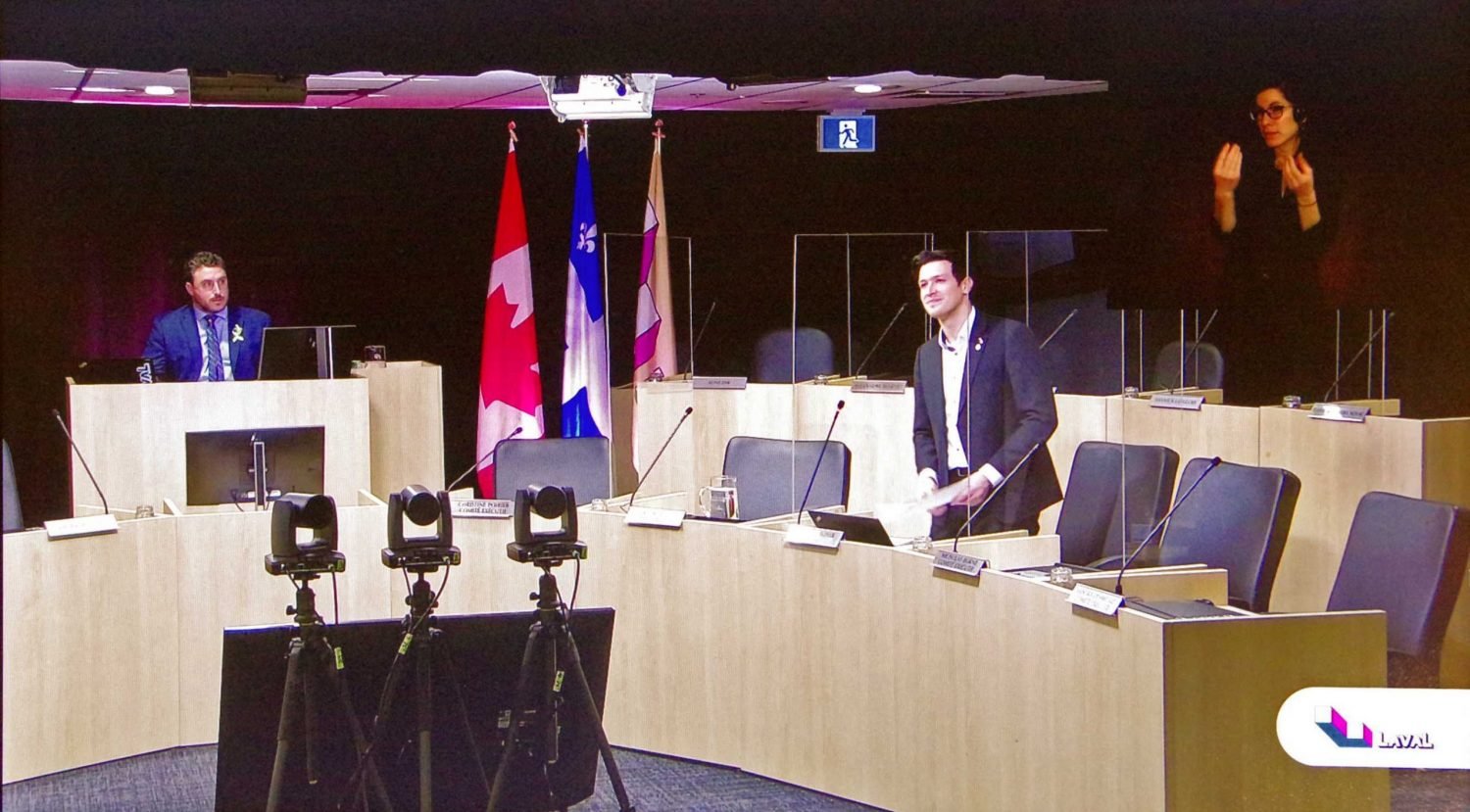
Mayor Stéphane Boyer, right, seen here with alternate council speaker Yannick Langlois, left, during the Feb. 1 Laval city council meeting.

However, the ground shifted noticeably during the Feb. 1 city council meeting webcast, after Alexandre Warnet, the councillor for Laval-des-Rapides and an associate executive-committee member responsible for environmental issues, spoke regarding the city’s acquisition of more than 400 lots of land for the expansion of the future Rivière-des-Mille-Îles nature reserve.

Backhanded remarks

Warnet, a highly respected environmentalist, referred to the acquisition – which includes several islands in the back river – as “historic” event. Fabreville councillor Claude Larochelle of the official opposition Parti Laval, praised the current administration for its actions, while later taking a moment to lament, if somewhat ambiguously, that past administrations did far too little to save Laval’s natural spaces from development.

“This is great news,” he said, noting that Éco-Nature, the organization mandated to oversee the project, had been working on the file since 2009. “I take my hat off to them,” he said. It was not long after listing some of the many protections that now safeguard the zone from development, that Larochelle fired off remarks which ended up offending at least one council member’s ears, when he added:

Attacks executive-committee

“Basically, the only element these lots weren’t protected against, I would say – and that’s what the recognition as a nature refuge by the government of Quebec is going to do – is that those lots weren’t protected from the City of Laval and its powerful executive-committee.

‘Be more respectful in your tone towards the executive-committee,’ Desmeules shot back at Larochelle

“For forty years, it was the City of Laval and its powerful executive-committee that mistreated our river banks, leading to the destruction of our natural areas,” Larochelle added. “Even in the case of the administration in which Mr. Boyer was a member for two terms, woodlands, like the Boisée Notre-Dame, were swapped for parking lots. They tried to sell a woodland, the Trait-Carré, to develop high-rises to pay our debt for Place Bell. And so, honestly, there was some protection missing: Protection against our very own executive-committee.”

Desmeules demands respect

With that said, Councillor Sandra Desmeules (Concorde-Bois-de-Boulogne), a senior member of the executive-committee, objected to Larochelle’s remarks in a point of order.

“It’s alright to have an opinion, I have no problem with that, but to come and attack the work of the executive-committee and the current administration,” she said. “I would maybe invite you to keep your comments and to be more respectful in your tone towards the executive-committee.”

Although alternate council speaker Yannick Langlois asked Larochelle whether he wanted to strike his comments from the record, Larochelle stood by his words, saying Desmeules hadn’t taken offence at anything specific he had said. Larochelle insisted he was referring primarily to Laval city councils over the past 40-50 years, and not necessarily to any specific administration.

Black History Month

In his opening remarks during the meeting, Mayor Boyer noted the importance of marking Black History Month in order to underscore the contributions of people from Laval who are from the Black community.

“This is an important occasion not only for pointing out the contributions of members of the community in our history, who often opened doors over time, and who achieved extraordinary things, but who also were leaders and models for our youths to follow towards the future.”

Boyer extended an invitation to all residents of Laval to take part in some of the special presentations the city is holding throughout February to mark Black History Month.

Tool and diemaking have been good for Chomedey machinist

He’s worked for Rolls Royce, Velan and others over the past 45 years

From the time he lived in Beirut until arriving in Canada in 1966, Jack Awakim had begun to think carefully about what he wanted to do with his life.

Would he turn professional as a boxer, remain a presser at a Montreal suit manufacturer, or become a skilled toolmaker and machinist for Montreal’s burgeoning engineering and aerospace industries?

In the end, the decision wasn’t difficult for the long-time Chomedey resident, now semi-retired at age 77 from a sometimes challenging but frequently interesting machining and toolmaking career.

As Jack related in an interview with the Laval News, his brother had come to Canada three years earlier to work as an aircraft mechanic and invited Jack, who was then 21, to join him. As early as age nine in Lebanon, Jack had developed an interest in boxing.

Choice of a career

So, by the time he arrived in Montreal, he was appearing as a contestant in amateur boxing tournaments at the Paul Sauvé Arena, on the same bill as local boxing stars like Donato Paduano, who competed in the men’s welterweight event at the 1968 Summer Olympics.

One of Jack’s first jobs in Montreal was as a suit presser at Peerless Clothing, the largest manufacturer of men’s and boys’ tailored clothing in North America.

However, by the mid-1970s, an acquaintance he’d met through his boxing connections saw that Jack seemed to have potential to do more meaningful work. So, he invited him to drop over for a job interview at J & R Weir, a shipbuilding company located at that time along the docks in Montreal’s east end.

Rolls Royce, Velan and Nordair

Although he initially started out as a cleaner, that became Jack’s first introduction to die-making and parts machining. For the next five years, he studied at a Montreal technical skills institute, finally becoming certified. He went on eventually to work for companies that included Velan Engineering, Rolls Royce Canada, Eastern Airlines and Nordair, although also as a freelancer out of his own office and workshop.

Tool and die makers are traditionally regarded as skilled artisans or craftspeople. They work from technical drawings provided by engineers or technologists, then cut and shape metal materials using a range of manually, or, more often today, computer-controlled machines than include lathes, jigs, grinders and drill presses.

However, precision in this particular trade is so acutely important that the sensitive measuring tools number in the dozens. To illustrate the point, Jack refers to what has become a textbook case among engineers for structural failure caused by minutely imprecise measurements.

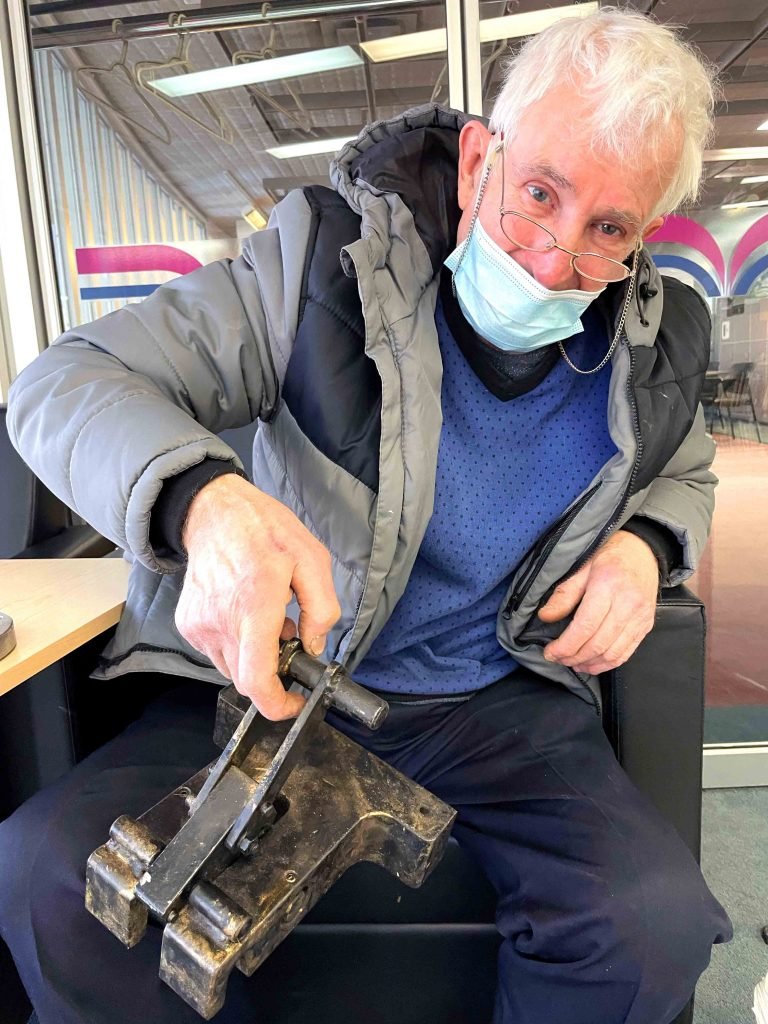
One of the pieces that Jack Awakim is most proud of is this example of a tow bar head he produced for an air transport company with a fleet of Boeing 747, Boeing 727 and Fokker 100 airliners. (Photo: Martin C. Barry, Newsfirst Multimedia)

Lessons from Shuttle Challenger

The explosion of the Space Shuttle Challenger happened in January 1986 because of the failure of two O-ring seals in a joint in the spacecraft’s solid rocket boosters. “Half a thou is something you cannot see just with your eyes,” Jack said, referring to a portion of a thousandth of an inch discrepancy that was discovered afterwards in the fitting of the O-rings.

As a result, and also because of record-low temperatures on the day of the launch, fluids and gases made their way through the tiny breach, igniting an external fuel tank on the Challenger.

Among the more interesting pieces Jack has made is a series of tow bar heads produced for an air transport company with fleets of Boeing 747, Boeing 727 and Fokker 100 airliners. When on the ground, aircraft sometimes need to be towed to maintenance or into position. But as aircraft usually have their own proprietary tow bar mechanism, Jack’s was relatively unique in that it could be used on the three airliners.

Well-rounded training

Mind you, the business has changed enormously since Jack began more than four decades ago. With the advent of computing in the manufacturing fields, tool and die makers have had to increasingly add skills in computer numerical control (CNC), computer-aided design (CAD) and computer-aided manufacturing (CAM) to their range of knowledge. However, today’s tool and die makers are generally also required to know the traditional skills in order to be well-rounded.

The business has changed enormously since Jack began more than four decades ago

Mathematics is an integral part of being a machinist. As such, students also learn the basic concepts of equations, formulas and trigonometry as applied to machining problems. As technical drawings and blueprints form the basis from which a machinist works to manufacture simple and complex parts, students also learn how to interpret industry-standard drawings and accurately identify various critical features and specifications.

Many job opportunities

Those who decide to follow this calling can become qualified for a range of job descriptions, including Lathe Operator, Reamer Machine Set-Up Operator, Machine Shop Layout Worker, Precision Grinder, Drill Press Set-Up Operator, Set-Up Operator, Milling Machine Operator and Machine Shop Maintenance.

Jack Awakim with several examples of pieces he machined for clients, many of whom were airline companies, over a career in tool and diemaking spanning more than 40 years. (Photo: Martin C. Barry, Newsfirst Multimedia)

While Jack says the business has been good for him, allowing him to live and raise a family in Chomedey, his advice to aspiring future die makers and machinists is that a good amount of the skill and craftsmanship will often be acquired only after you’re on the job and gaining experience. “They teach you the basics in school, but there are still many other things they don’t teach you,” he said.

Laval News Volume 30-05

0

The current issue of the Laval News volume 30-05 published February 9th, 2022.
Covering Laval local news, politics, sports and our new section Mature Life.
(Click on the image to read the paper.)

Front page of the Laval News, February 9th, 2022 issue.

Quebec announces lifting of most Covid pandemic restrictions by middle of March

In the latest of a series of post-Covid reopening announcements, Quebec Premier François Legault said early Tuesday afternoon that the province’s bars can reopen, organized sports can resume and there will soon be no limits on the number of people allowed to gather in one place.

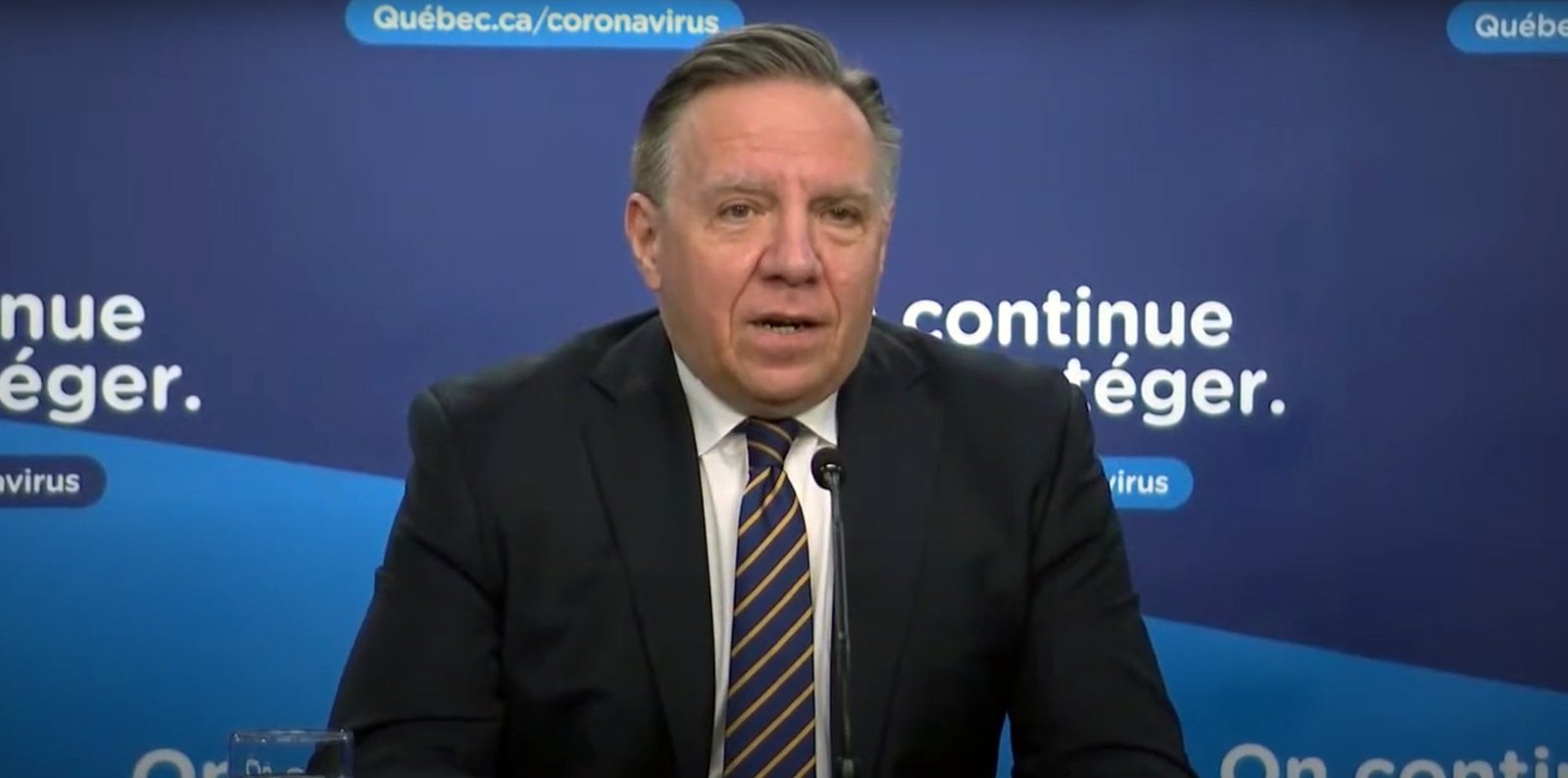
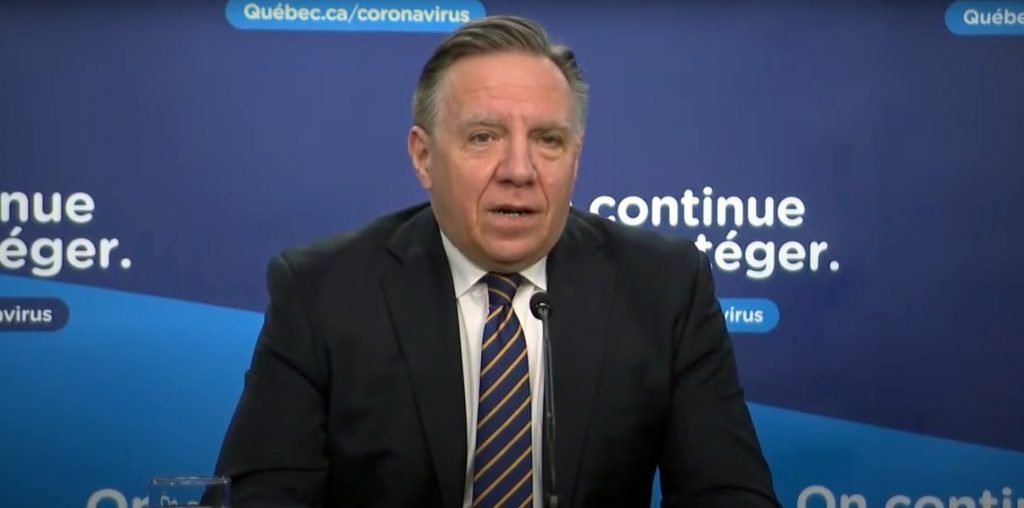
Quebec Premier François Legault announced the lifting of more COVID-19 restrictions on Tuesday afternoon.

Since December, when the arrival of the Omicron Covid variant set back the province’s reopening plans, Quebec had returned to an overnight curfew over a period of several weeks, along with a widespread shutdown of businesses and limitations for gatherings.

As of Saturday Feb. 12, there will no longer be restrictions on home gatherings, although it is still being recommended that no more than 10 people should be present.

Restaurants will be allowed to serve no more than 10 people at a single table.

On Monday Feb. 14, gyms and spas will be allowed to reopen, and organized sports will also be allowed to take place once again on that date, although tournaments cannot be held until Feb. 28.

All retail stores will be allowed to operate at full capacity beginning on Feb. 21.

Bars will also be reopening on Feb. 28, although only at half capacity, with no dancing or karaoke allowed until March 14.

Laval swingers’ club owner fined $24,000+ for tax evasion

0

Quebec’s official tax collector, Revenu Québec, says the owner of a Laval-based club that catered to wife-swappers and swingers must pay a more than $24,000 penalty after being found guilty of not paying provincial sales and income taxes.

Laval Police Department related news

Alain Joyal, 61, a Montreal resident, pleaded guilty to three charges on Jan. 10 at the Palais de Justice de Laval. Joyal is listed in the provincial registry of businesses as the sole owner of Gestion 10 133 inc.

The holding company did business as Club Frenchkiss on Cunard St. in Laval’s industrial park, although the club is now closed. According to a Revenu Québec press release, the tax agency opened an investigation into Joyal’s business dealings after being tipped off by the Laval Police Department.

The LPD told the agency that Gestion 10 133 inc. was organizing swingers’ evenings where alcoholic beverages were being sold. Neither Gestion 10 133 inc. nor Club Frenchkiss had a Quebec liquor permit.

The investigation revealed that from 2014 to 2017, the company failed to report and to remit to Revenu Québec sales taxes that it collected, an amount calculated to be $17,325.32. As well, the company was found guilty of not paying the business income tax during the same period.

Apart from the sale of liquor, court documents revealed that Club Frenchkiss also derived revenue from membership fees, event tickets, renting out bedrooms in the club and fees for coat check services. During the time it was open, the club’s hours were from Thursday to Saturday evenings, and sometimes on Sundays for special events.

Court statements also suggest that the company wasn’t very good at record-keeping. The owner wasn’t using an efficient accounting system and the company’s accounting data was incomplete.

The LPD turned the matter over to Revenu Québec after executing a search warrant at Club Frenchkiss in 2017, based on an allegation that the club was operating in violation of local zoning requirements, which forbade operating a bar in that area. Consequently, nearly 800 bottles of liquor were seized by the police. As well, Revenu Québec executed a search warrant at the owner’s home on Île Bizard in Montreal in May 2018.

Ottawa introduces new measures to speed up immigration processing times

Trudeau gov’t hopes to stimulate economic recovery, while changing ministry practices

Federal Minister of Immigration, Refugees and Citizenship Sean Fraser has announced new measures, which should help speed up immigration to Canada.

Fraser said during a webcast press conference last Monday that the government will be getting back on track by the end of 2022, after COVID-19 caused a major backlog over the past two years in the processing of immigration applicants.

“These measures are part of a broader process to address key challenges faced by our clients, and achieve the more predictable processing times that our clients expect and deserve,” Fraser’s ministry said in a statement.

More staff to be hired

Last year, the Trudeau government announced it would spend $85 million to deal with the backlogged immigration department applications. Fraser said on Monday that the sums will be used primarily to hire additional staff.

He said the new immigration workers will assist the government in getting back to normal processing times for study and work permits, permanent resident renewals, visitor visas and proof of citizenship applications. However, not on the list of priorities is family unification applications. According to Fraser, they already meet the ministry’s standards for processing time.

Process delays frustrating

“I know that processing delays have been incredibly frustrating for many individuals,” Fraser said. “Helping clients come to Canada quickly, with predictable processing times and efficient communication with IRCC, remains a top priority for me.

Canada’s Minister of Immigration, Refugees and Citizenship Sean Fraser announced changes to the country’s immigration policies in Ottawa last Monday, designed to speed up processing which had been slowed during the Covid pandemic.

“Many people are choosing Canada as the place to visit and build their future,” he added. “And to ensure that we stay competitive, we have introduced concrete measures to make sure those who want to come to Canada have the client experience they deserve.”

Dealing with labour shortages

According to Fraser’s ministry, immigration is playing an essential role in helping to address some of the most severe labour shortages brought on by the pandemic. However, the remaining challenges continue to include the processing delays, as well as postponements for applicants hoping to come to Canada to work or to reunite with their families.

While the ministry says Canada welcomed the highest number of permanent residents in a single year in 2021 by processing a record number of applications, border restrictions and other pandemic-related factors led to delays for many applicants.

Applications from outside

The ministry says it has already hired approximately 500 new processing staff, taken measures to digitize applications and reallocated work to ministry offices around the world. To help accelerate the processing work, they are expanding the use of advanced data analytics in helping officers sort and process visitor visa applications submitted from outside Canada.

The federal Ministry of Immigration, Refugees and Citizenship is introducing new methods to speed up processing times. (Photo: Courtesy of Canadian International Council)

“We understand that clients want easier access to status updates on their case files,” the ministry says in its press release. “That is why we will also introduce a new Permanent Residence Application Tracker in February 2022 for spouses and dependents, to allow clients to easily access their application information and status online.”

Virtual citizenship ceremonies

For citizenship applicants, IRCC has also introduced online testing, developed an online application tracker and launched virtual citizenship ceremonies. Over the last few months, they have hosted approximately 350 virtual ceremonies per month, and more than 170,000 new Canadians have been sworn in since April 2020.

They are continuing to expand the use of virtual ceremonies. Moving forward, they are exploring an option for those who wish to self-administer the oath of citizenship by signed attestation and celebrate their citizenship at a later date.

City takes action to create Rivière-des-Mille-Îles nature preserve

The Laval executive-committee is asking city council to approve measures that will pave the way towards creating one of the largest nature reserves in Quebec along the edge of the Rivière-des-Mille-Îles.

The first phase of the plan calls for the inclusion of 432 municipal land lots (568 hectares), including islands in the river. The lots in question are already within an area defined as protected by the city.

The new status will grant them additional protection. The project initially got underway following a recommendation made by the Laval-based non-profit nature conservation group Éco-Nature.

“I am proud of this step forward towards the realization of my commitment, big news for Laval residents,” said Mayor Stéphane Boyer. “These additions will multiply by a factor of 20 the area of this protected zone, making an area around twice the size of Central Park.

“The refuge is home to around two-thirds of the animal species in Quebec,” Boyer continued. “By protecting and by connecting these areas together, we will be encouraging the survival and reproduction of hundreds of animal and plant species that live there, while also ensuring people from Laval access to their nature heritage.”

The provincial government is also very enthusiastic about the City of Laval’s plan. “The Rivière-des-Mille-Îles nature refuge is an exceptional site from the point of view of fauna as well as flora and is an area with very high biodiversity,” said Pierre Dufour, Minister of Forests, Fauna and Parks in the CAQ government.

Calling the 568-hectare preserve “a considerable area for protection on private lands,” Dufour said the city’s move is “an important step and an important advantage in the enlargement project for the Rivière-des-Mille-Îles nature reserve ever realized by our biologists in conjunction with Éco-Nature.”

“For more than 20 years, the City of Laval has supported, through real measures, the mission of Éco-Nature to protect, conserve and promote the rivière des Mille Îles and its tributaries,” said Éco-Nature director-general Christine Métayer.

“The addition of these islands, shores and wetlands to the nature refuge is the most recent example. The entire team from the Parc de la Rivière-des-Mille-Îles is overjoyed with this decision. The people of Laval should feel proud of the commitment by their mayor and his commitment to this magnificent ecological, recreational/touristic project, a major legacy for future generations.”

Among the islands in the Rivière-des-Mille-Îles that will become part of the nature preserve are l’île aux Vaches and l’île Saint-Pierre, which were purchased by the city in 2020. The city says that a third island, l’île Locas, is about to be purchased and the transaction is near the point of being completed.

Laval allows property tax late payments and in two installments

The City of Laval says that due to ongoing economic fallout from the Covid pandemic, property tax bills for the year 2022 will be payable in two installments, due in June and in September. The due dates for the installments are also being extended.

According to the city, the first installment (which had initially been due on March 23) will now be payable no later than June 15. The second installment (which would normally have been due on June 21) is now payable no later than Sept. 13.

“The effects of the pandemic continue to be felt within many families in Laval,” said Mayor Stéphane Boyer. “We hope to help lighten the load for them, allowing them to benefit from a few months of respite in order to better plan their budgets. This boost will also be applying to businesses in Laval.”

City receives certification for stance against domestic violence

The City of Laval has become the first municipality in Quebec to become certified by the provincial government for its efforts to help reduce domestic violence through support provided in the workplace.

Sponsored by the provincial government, the program was launched on Jan. 25 by Isabelle Charest, the minister for women’s issues in the CAQ government. Quebec banking corporation Groupe Desjardins is the only other organization to have received the certification so far.

Through the certification, the city acknowledges its responsibility as an employer to take action when a situation involving harassment by the spouse of an employee arises in the workplace. The city has also pledged to adopt a workplace policy whose goal will be to put into place preventive measures to stop domestic violence.

“The city wishes to facilitate and encourage employees caught up with domestic violence problems so that they can ask for help and to make the situation known,” said Laval Souvenir-Laval city councillor and executive-committee member Sandra El-Helou, who is responsible for women’s issues dossiers on council.

“We hope to have a workplace environment that is respectful and empathetic and where people know they are supported and not alone,” she added. “This is an employer’s responsibility, although mostly a human responsibility.”

In Laval, there are three shelters for women and children who are victims of domestic violence: Maison de Lina (450 962-8085), Maison L’Esther (450 963-6161) and Maison Le Prélude (450 682-3050). Their services are confidential and are offered 24 hours out of 24, 7 days out of 7.

Here are some other resources:

  • SOS domestic violence | 1 800 363-9010
  • CAVAC de Laval | 450 688-4581
  • Centre des femmes de Laval |514 808-2909
  • Athena’s Shield (multilingual services) | 450 688-6584
  • CISSS de Laval
  • And in case of emergency, call 9-1-1.

Weather

Laval
broken clouds
0.7 ° C
0.7 °
0.7 °
80 %
4.6kmh
77 %
Sat
10 °
Sun
8 °
Mon
14 °
Tue
15 °
Wed
16 °