Environment Canada issued a warning Saturday morning that a few hours of freezing rain can be expected overnight and into Sunday morning in an area just north of the Laval region.
The freezing precipitation is expected to mainly affect the North Shore of Montreal, said the weather service, but also communities surrounding it, and is expected to continue until after 3 am Sunday.
The War Amps began its 2022 key tag mailing to Laval residents last week with the theme ‘You Make Our Programs Possible.’
Antoine Doan, 23, of Laval, is a left leg amputee, and he grew up with help from The War Amps Child Amputee (CHAMP) Program, which provides financial assistance for artificial limbs and adaptive devices, as well as peer support.
Antoine Doan of Laval received help from The War Amps Child Amputee (CHAMP) Program, which is supported by the War Amps Key Tag Service.
“The War Amps has been an important part of my life since I was a toddler,” says Antoine. “Growing up, I had the opportunity to meet kids just like me at the seminars. Thanks to the association’s support, I have learned to be confident and overcome challenges with a positive attitude.”
The Key Tag Service was launched in 1946 so that returning Canadian war amputee veterans could not only work for competitive wages, but also provide a service to Canadians that would generate funds for the association’s many programs, including CHAMP.
The Key Tag Service continues to employ amputees and people with disabilities, and has returned more than 1.5 million sets of lost keys to their owners. Each key tag has a confidentially coded number.
If you lose your keys, the finder can call the toll-free number on the back of the tag or place them in any mailbox in Canada, and The War Amps will return them to you by courier, free of charge.
The War Amps receives no government grants and its programs are possible through public support of the Key Tag and Address Label Service. For more information, or to order key tags, visit waramps.ca or call toll-free 514 398-0759.
Prime Minister Justin Trudeau’s office issued a statement Wednesday evening saying he spoke earlier in the day with the President of Ukraine, Volodymyr Zelenskyy, to express solidarity and extend further support to the people of Ukraine.
Ukraine President Volodymyr Zelenskyy. (Photo: Courtesy Government of Ukraine)
According to the PMO, Trudeau commended Zelenskyy for his “outstanding bravery and front-line leadership,” calling it inspirational for Canadians and people around the world.
The PMO said Zelenskyy thanked Trudeau “for announcing meaningful and punitive sanctions against Russian banks and oligarchs in Russia who are directly responsible for this unprovoked invasion or help support it.”
The statement said that Zelenskyy also welcomed Canada’s announcement of further military support.
The PMO said Trudeau reiterated his commitment to continue supporting the Ukrainian people, “while working alongside allies and international partners to hold Russia accountable for its unjustifiable and illegal invasion of Ukraine’s sovereign territory.”
The two leaders discussed ways in which Canada could continue to support Ukraine in the immediate future.
The PMO said Trudeau asked that President Zelenskyy keep safe and wished him well in the coming days.
Quebec’s UPAC anti-corruption police unit announced on Monday that an investigation it launched five years ago into alleged corruption in the Quebec Liberal Party’s fundraising has concluded without charges being recommended.
In a statement issued Monday by UPAC, the agency said it wanted to limit its comments on the outcome of the investigation.
Probe ended
“Considering the legal opinion obtained, as well as all the rigour and the resources already invested in this investigation, the commissioner finds there is no reason to prosecute the latter and therefore puts an end to it,” UPAC said.
“In order not to harm ongoing legal proceedings, and given the obligations of confidentiality applicable to the content of police investigation files, the commissioner must refrain from any other comment,” the agency added.
UPAC’s director Frédérick Gaudreau.
The announcement came as former Quebec Liberal premier Jean Charest, who was among the senior Liberal Party brass investigated by UPAC, is contemplating running to become the federal Conservative party’s new leader.
Charest lawsuit
In the meantime, the former premier is suing Quebec’s CAQ government, alleging that police leaked information related to the investigation to the media.
UPAC’s Mâchurer investigation focused on the methods of financing the PLQ was alleged to have used between 2001 and 2012, looking into possible links between fundraising activities and the granting of public contracts.
Lawyers for Charest recently asked a judge to speed up the delivery of documents Charest requested for use in his lawsuit, which he launched in October 2020.
No charges by DPCP in death of Chomedey woman last year
A year after a woman was found dead under mysterious circumstances on des Châteaux St. in Chomedey, the office of Quebec’s Directeur des poursuites criminelles et pénales (DPCP) says it is not recommending charges of negligence against Laval Police Department officers.
Last year, the Bureau des enquêtes indépendantes (BEI), which investigates deaths occurring when police are involved, said it was launching an investigation into the woman’s death. The 32-year-old was found on Feb. 21 outside a condo complex near des Châteaux and Daniel Johnson Blvd.
In a statement issued last week, the DPCP said that after examining a report produced by the BEI, it concluded that officers from the Laval Police Department had not committed any criminal infraction.
According to the DPCP’s account of last year’s incident, the woman called 9-1-1 to complain that she had received threats from a man, although she subsequently refused to identify him.
A short time after this, two police officers from the LPD turned up at her home to investigate. However, for reasons having to do with the Covid pandemic and protocols for reduced contact between persons at that time, they contacted the complainant by telephone rather than in person.
After visually inspecting the area from their police car and concluding there didn’t appear to be a suspect around, they called the woman. They noted afterwards that at no time during their conversation did the woman say anything about “death threats,” only that the suspect had used threatening language, and that what she told the 9-1-1 operator didn’t line up with what she told the officers later.
Among other things, the officers said they contacted the man that the woman said she was afraid of, and warned him about the limits of speech before it becomes a criminal threat. They said he reassured them that he wished no harm to the woman, was polite, and the call ended.
Around 7 am on Feb. 21, the woman was found dead in the outdoor parking lot of the building on des Châteaux St. where she lived, and a firearm was found near her body. Despite the DPCP’s exoneration of the police officers, an investigation into her death is still underway by the Sûreté du Québec.
Some recent fire calls
· Feb 28 · 2:42 PM
Fire in Progress
Building fire on Saint-Martin Blvd. Ouest in Chomedey sector. One-storey residential building. Smoke visible on the roof. Code is 10-07, meaning intervention necessary.
Streets to avoid:
Robinson and Gratton
· Feb 22 · 1:03 PM
Fire in progress
Building fire on 73rd Ave. in the Chomedey sector. Two-storey, multi-unit residential building. Smoke visible. Code was 10-07, meaning intervention necessary.
The City of Laval’s executive-committee gave the go-ahead last week for city council to proceed with the purchase of two lots located south of Saint-Elzéar Blvd. and east of Curé Labelle Blvd. in order to add them to Laval’s growing network of green spaces and forestlands.
Last September, the city had declared certain pieces of land to be on reserve status for two years, in order to prevent any developers from snatching them up.
This, according to the city, would give the municipal officials, enough time to negotiate their purchase from the owners, and allow the lots to be protected ecologically and improved with that in mind.
A group of residents had been lobbying the city to declare a moratorium on development of those properties at the same time.
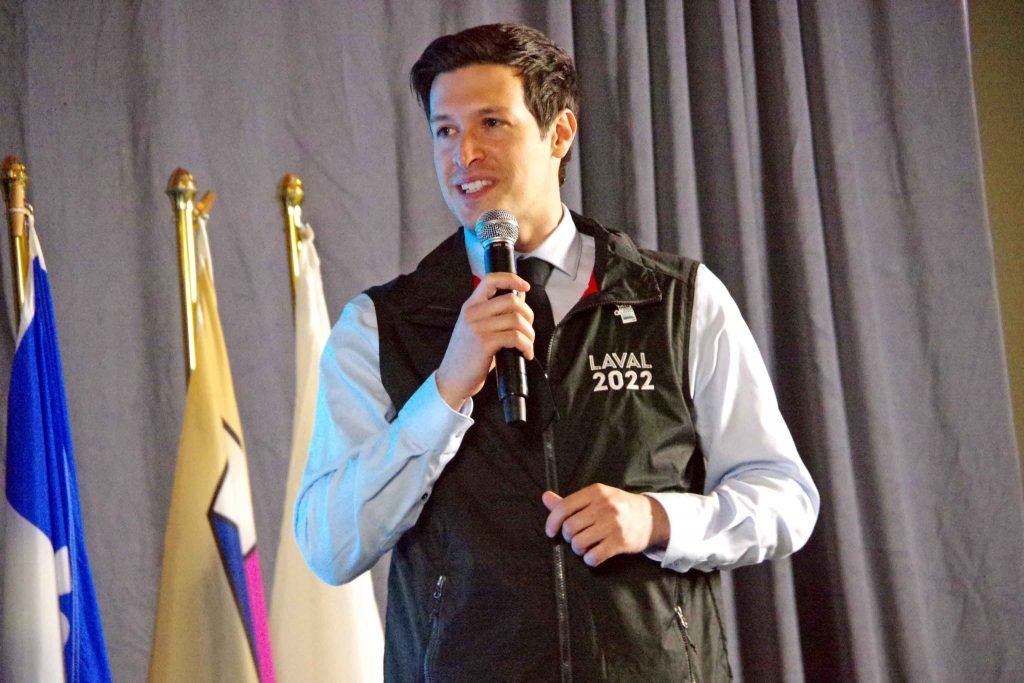
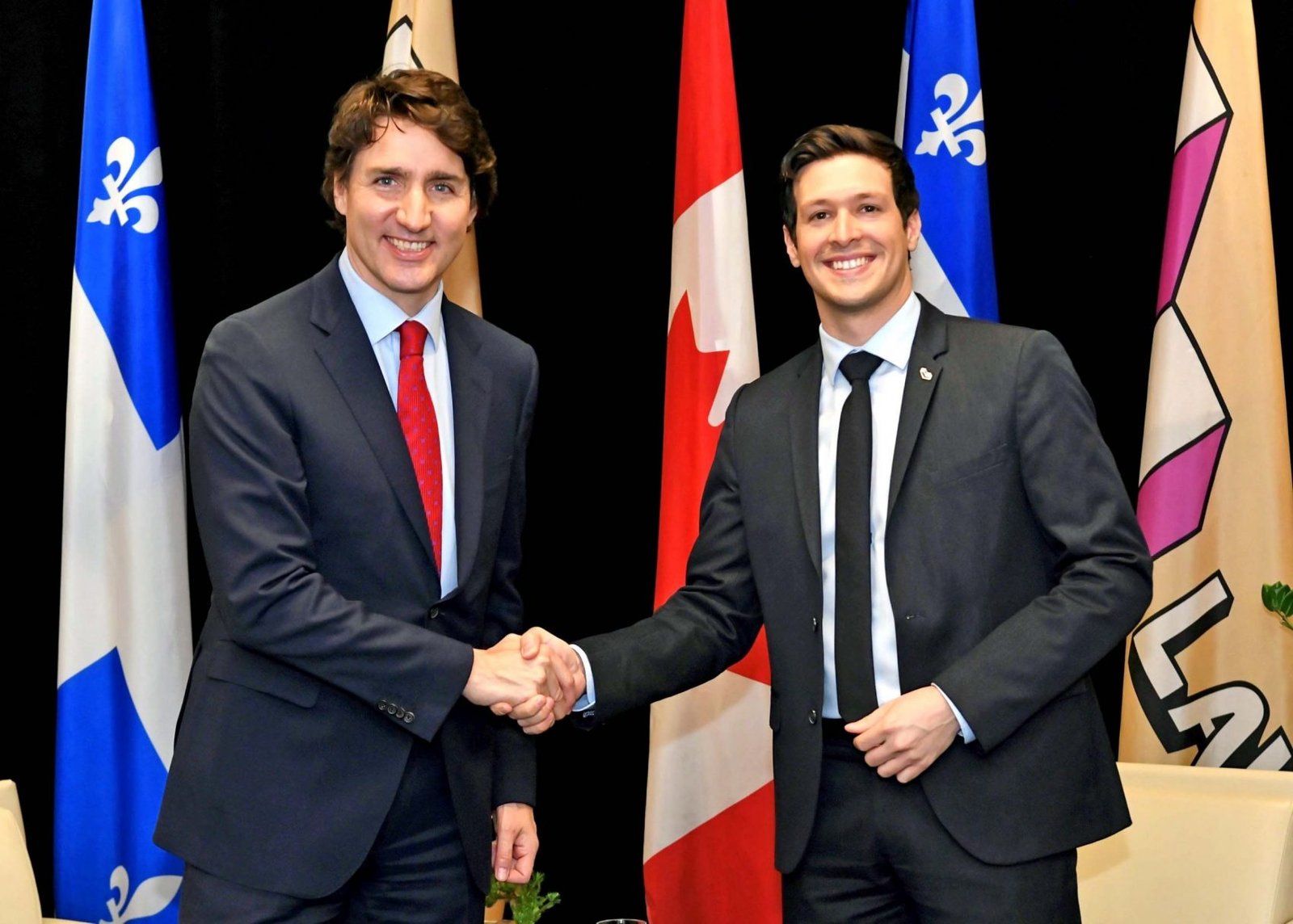
“When the struggle against climate change remains ongoing and it is more important than ever to promote biodiversity, we are especially proud to be able to invest in the protection of these natural spaces which are of immense ecological value,” said Mayor Stéphane Boyer.
“With this purchase, we are taking yet another step towards achieving our goal of investing $100 million for the protection and promotion of our natural spaces. What should also be remembered is that a significant part of the area to be acquired would have been developed if the city had not stepped forward to become the buyer.”
Covered extensively by swamps and wet areas, the lots in question are crossed by the Papineau-Lavoie stream. As the last remaining natural spaces in the middle of an area of Laval that has become quite densely built up, it is believed the lots will help deal with the “heat island” phenomenon which has become a common characteristic of urban living.
“The protection of these natural spaces will allow biodiversity to be maintained in this sector, while filtering water passing through the area, and improving the flow of water along the Papineau-Lavoie stream,” said Laval city councillor for Laval-des-Rapides Alexandre Warnet, who sits on the executive-committee with responsibilities for environmental dossiers.
City gave $600,000 to development agencies to help re-start post-pandemic economy
City of Laval officials announced on Feb. 24 that the city granted $600,000 in subsidies in 2020 and 2021 to a social economy development agency as well as to a fund that encourages young entrepreneurs, as part of a municipal campaign to help jump-start the post-pandemic economy in Laval.
The Fonds Jeunes Promoteurs (FJP) and the Fonds Économie Sociale (FES) will are distributing the subsidies to 25 Laval-based businesses. According to the city, the support is part of an overall $1.9 million package of funding which helped to create 65 jobs.
“Subsidies paid out to young entrepreneurs led to the creation of 10 businesses,” said Mayor Stéphane Boyer.
Amélie Proulx, co-founder of Épicerie Alterrenative, which has benefited from the subsidies. (Photo: Courtesy of City of Laval)
“As for the amounts allotted to the FES, they were able to start three businesses while financing 12 growth-oriented and innovative projects on our territory. “We believe firmly that entrepreneurialism plays an important role in re-starting our economy,” he added.
“This is why we support businesses through financial assistance, but also through strategic counselling and guidance in all phases of their development. Don’t hesitate to call upon the services of Laval’s economic development department.”
Bars and cinemas reopen to full capacity, but vax passes still required
Whatever else may be going on in the world right now, there is good news at least here in Quebec with the provincial government’s ongoing plan to loosen Covid restrictions – beginning last Monday.
Since last Monday, bars, which had been closed since the beginning of the pandemic, are finally reopening, even though dancing and karaoke remain forbidden for now.
Full operating capacity
According to the revised rules, theatres and events venues that can accommodate up to 10,000 people, including the Bell Centre in Montreal, can now reopen to 100 per cent capacity.
Since last Monday morning, cinemas and movie theatres have also been allowed to operate to 100 per cent capacity, and the same applies to casinos. Bars, restaurants and casinos can now stay open until 1 am, although food and drink service must end at midnight.
But at the same time, the use of vaccine passports remains mandatory for admission to restaurants, bars, show venues and film theatres. For work places which are gradually reopening, the use of face masks is no longer mandatory in the work place.
Sports events resume
Sports tournaments and competitions are being allowed to resume in municipal facilities as well as in schools. However, the use of face masks is still being recommended for youths 13 years of age and older.
As of last Monday, cinemas and movie theatres can operate to 100 per cent capacity
Senior citizens living in CHLSDs and similar facilities for the retired may now gather in groups of up to 10 at tables in dining rooms. But at the same time, the government is recommending that visits be limited to a maximum of 10 persons.
To paraphrase a well-traveled truth that if mistakes of the past are ignored, they return with a wallop far stronger than their original impact, creating precedents that could be abused by future generations.
Prime Minister Trudeau’s revocation of the Emergencies Act this past week, before it barely became operative, leaves many questions unanswered. Where is all this heading?
A bit of history, many questions. In Canada, The War Measures Act of 1914, temporarily shifted power from parliament to executive branch of government, giving Prime Minister and Cabinet arbitrary jurisdiction in adopting emergency measures in times of war, invasion, or ‘apprehended insurrection’. Understandably, the act was put into force during two world wars, but not so clearly understood is the reason why it was also invoked in the 1970 October Crisis, or more to the point – why it was passed, and then quickly revoked, last week, in response to the freedom convoy that hit Ottawa late January 2022, disrupting the city, according to some, for three weeks.
Potential and actual abuses of emergency powers were exposed in the 1970s, following Pierre Elliott Trudeau’s controversial invocation of the act in 1970, a widely-criticized move, prompting comprehensive constitutional revisions that brought all emergency powers within constitutional provisions. When war, rebellions, and threats to peace and order erupt, most constitutional governments suspend usual procedures to deal with regime-threatening conflicts.
This is what Canada would have had to abide for at least a month, before the Prime Minister made an about face. Nonetheless, the situation regarding emergency powers is noteworthy.
Canada has faced substantive threats through most of its history. Nineteenth-Century rebellions were put down by expanding national governments. Twentieth-Century real emergencies were declared in two World Wars. Suspicious invocation of the act in 1970 engendered criticism of the government’s use of emergency powers and led to reform efforts – The Constitution Act of 1982. In recent weeks, ‘Emergency’ – referring to commonsense approaches to crisis resolution – has escalated to heated debate over appropriate use of martial law.
Martial law is regarded as suspect by constitutional scholars who condemn its peacetime use because it rests upon no settled principles, entirely arbitrary in its application. It’s not law, indulged rather than allowed, unjustified in peacetime, the illegitimate cousin of military law. A notion of legality inherited by modernday Canada. However, Canada’s martial law is now reduced to matters of executive declaration.
A good look at how the so-called trucker convoy emergency was defined and handled by government/political leaders provokes pertinent questions. The critical question, the answer to which is essential to the preservation of the rights of all Canadians, is: Did the 2022 Canadian government overreact and then overreach/overact by ramming through the House of Commons the subsequently-suspended Emergencies Act? The proposed legislation became law with the support of only two-offive sitting political entities in the House – the Liberals and the NDP in a rather tight vote of 185 to 151.
Agreed, on extreme occasions, every prime minister/head of government must be ready to risk going beyond the strict lines of law, when the preservation of public security requires it. As it turns out, Prime Minister Trudeau declared the equivalent of martial law, claiming the presence of a local insurrection. If so, why didn’t Federal Public Security Minister Marco Mendocino act earlier, from the start? Why didn’t the Prime Minister meet with the convoy leaders, at their request? His response: ”Why should I meet with you? You’re racist, misogynist, and terrorist. And if that’s not enough, he painted all non-vaxxers and protest supporters with the same brush. Why did Trudeau in the House of Commons accuse an opposition Jewish Member of Parliament of supporting terrorists who carried Swastika flags (one flag, to be exact) when she said the Prime Minister was abusing his power.
Was the government’s handling of the freedom convoy an anachronistic understanding of the Constitution of Canada on the Prime Minister’s part? Yes, the Constitution explicitly allows local legislatures to ask federal protection against domestic violence. But when is martial law, or its equivalent, presumably allowed or justified? Unquestionably, to stop armed insurrection too strong for civil authority.
Competent authorities must determine what degree of force the crisis demands and if the government must resort to wartime conditions to maintain itself to overcome unlawful opposition. After much deliberation – was the public safety really at stake during the truckers’ demonstration? Was the emergency real? Why did Ottawa Chief of Police Peter Sloly reach a “mutually agreeable separation” with the Ottawa Police Services board amid heavy criticism for not being tough enough with truckers and protesters? Why would Canadians be subjected to privacy invasions legalized by Emergencies Act provisions allowing government to freeze their bank accounts?
It was reported by some non-compliant-to-government media, that the bank account of a Canadian single mom was frozen because she donated $50 to the truckers through the GoFund campaign, donating when it was still legal. This isolated but potentially widespread act-of-invasion-of-privacy was morally doubtful at best and potentially criminal at worst, neither of which is acceptable in a supposedly free society such as Canada claims to be.
Although The War Measures Act gave sweeping powers to the executive, it stipulated that to exercise these powers there ‘‘shall be conclusive evidence that war, invasion, or insurrection, real or apprehended, exists.” The executive was also explicitly given the power to censor media; arrest, detain or exclude persons; control ports and transportation; control commerce; and appropriate, control, forfeit, and dispose of property.
The question now is: Why did the Canadian Civil Liberties Association question Trudeau for what it considered overreach and violation of constitutional rights? Why were some protesters roughed up by police (video evidence)? Why were convoy leaders denied bail after being charged with unsubstantiated crimes? Why does the Canadian population have to rely on non-Mainstream Media outlets to challenge Trudeau’s questionable attempts to arbitrarily oppress all Canadians with The Emergencies Act, while most Mainstream Media, sang the same song, uncritically, without any healthy skepticism, continually reflects what appears to be an imbedded approach to reporting on the happenings in the nation’s capital? Furthermore, why did the NDP support the Liberals by voting with them to pass the Act, exhibiting no respect for those of the party who have been fighting for human-rights-for-all since the 1930s.
No mainstream media pointed to problems arising from provisions of the Act. Since the defense of liberty and property of individuals rests with the provinces and not with the national government, the key constitutional question raised by many experts is whether the powers seized are within the range of federal power. This may be behind Alberta’s intent to challenge the Act if it became operative. Are these extraordinary times which necessitate extraordinary measures? Peaceful, although boisterous, truckers? Extraordinary times? A real head-scratcher!
It’s unthinkable that the Emergencies Act could have led to dictatorship and oppression, even in short spurts of time in 2022, yet there’s clear evidence that democracy was in temporary perilous suspension under an authoritarian government. Is this what our forefathers fought for and died to avoid?
It’s unclear if an emergency actually existed. Was there a real emergency, or was it fabricated by authoritarian forces who wanted to shackle everyone with the yoke of submission-to-authority. “You either do as we tell you, or you will have your rights curtailed. If you don’t submit (to vaccines). You will lose your rights.”
The one sacred thing in democracy is freedom from government oppression. There is protection under Canadian Constitutional Law that the governing class governs from the consent of the people. The people don’t exist because of the government; government exists because of the people. Democracy must prevail.
Chomedey residents seething over snow-cluttered streets and unplowed sidewalks
In spite of claims over the past few winters by Laval officials that they’ve managed to resolve many of the city’s long-standing snow removal problems, homeowners on certain key residenial streets in Chomedey are complaining once again about uncleared sidewalks and other examples of what they say is mismanaged snow removal in Laval.
The City of Laval claims to have beefed up its snow removal strategy with, among other things, a smartphone app that allows residents to track snow removal operations in real-time.
As well, a major change was announced last spring to the winter parking regulations on residential streets. As of this winter, car owners are no longer obliged to park on alternating sides during the winter months.
New parking rules this winter
Chomedey resident Andreas Pantelis stands on the edge of his property on Bennett Ave. last Sunday His left-hand points to where the sidewalk normally should be, but where the Bombardiers mini-plows hadn’t passed for at least a week, he maintained. (Photo: Martin C. Barry, Newsfirst Multimedia)
According to a press release on the new parking strategy circulated by the city last May, car owners are now free to park on either side of the street during the winter, but must still “alternate” when snow removal operations start.
When city officials made the announcement last spring, they estimated that the number of days requiring alternance would drop from 150 to 36 per year. Prior to the change, vehicles had to be moved from one side of the street to the other every weekday from Oct. 1 to April 30.
In addition to this, for a number of years now the City of Laval has been encouraging its residents to download and use its “Info-Stationnement” smartphone app (available for iPhones through Apple’s App Store, and for Android phones through Google Play), in order to better understand the street parking situation during the winter months.
City recommends app use
A press release issued by the city in October last year advised residents not to judge the state of snow removal ops only from what they see on the street, but to rely on the information provided by the app, text messages sent out by the city, or by calling the 3-1-1 public works phone service.
With all that being said, it means little to some residents on certain streets in Chomedey, where, they claim, the snow removal – and especially the de-icing and plowing of sidewalks – was especially lamentable in recent weeks, after Laval got whacked by several winter storms.
“Ten days,” Andreas Pantelis of Chomedey’s Bennett Ave. called out to a reporter last Sunday afternoon from the front steps of his home, noting the number of days the sidewalk on his street hadn’t been cleared, he said. This in spite of at least two ice and snow storms that roared through Laval over the past two weeks or so.
Can’t get past snow banks
Pantelis, who suffers from a heart condition that prevents him from engaging in strenuous exercise like snow shovelling, said he and his wife couldn’t get their car our of their driveway because of the enormous mounds of snow piled on the unplowed sidewalk in front of their home.
Added to this, he said, Bennett St., like so many other streets in this part of Chomedey, is narrow. As such, the snow banks piled on each side, that the city had yet to pick up, created a large-impassible channel for cars to navigate.
A few streets west of Bennett, on Clarendon Ave. near the corner of Notre-Dame Blvd. where Nick Furfaro has his home, the problem was the same: As of last Sunday, the sidewalk that passes in front of his and all the other homes on the street hadn’t been plowed by the mini-Bombardier for around a week.
The view along de Cherbourg Ave. in Chomedey last Sunday, where the city had posted signs advising residents not to park because of imminent snow removal operations. (Photo: Martin C. Barry, Newsfirst Multimedia)
Many senior citizens impacted
A helluva situation in a neighbourhood where a very large percentage of the residents are senior citizens, who would have trouble enough navigating their way in the dead of winter along icy sidewalks, even under the best of circumstances.
“Firstly, the snow has not been removed as it used to be,” Furfaro said. “But you can’t access the sidewalks, either. You’ve got to walk on the street because the sidewalks haven’t been cleared. The snow removal from the previous heavy snowfall hasn’t been removed, and the one that just happened added to the volume.”
On Thursday morning last week, according to Furfaro, residents of Clarendon found themselves being serenaded by the sound of a passing tow truck’s loud horn, warning to move their cars because snow-blowing was about to start.
Snow-removal signs not put up
“But there were no signs put on the snow banks like they used to,” he said. “And the last time they removed snow they did not put signs warning the citizens that there would be snow removal. So, we have no way of knowing when it is they’re going to be removing snow.”
And then there is the parking situation. Despite the city’s insistence that it cleared up whatever confusion there had previously been over the winter parking regulations, it would seem that not even City of Laval employees are entirely clear on the new concept.
Furfaro said that last week, he saw a parking officer with the City of Laval going around ticketing cars parked on a side of Clarendon where, according to his reading of the regulations, parking is supposed to be permitted during the winter months.
Confusion over parking rules
“One of my neighbours was about to get a ticket, and the ticket was placed on his car and [the ticket officer] was going onto the next car. I said to him you cannot give a ticket when we are parked on the right side. We are allowed to park on our side unless there are snow removal notices.
Nick Furfaro of Clarendon Ave. in Chomedey is seen here last Sunday standing on the east side of the street with the area behind him being the sidewalk which for the past week at least had not been plowed. (Photo: Martin C. Barry, Newsfirst Multimedia)
“He said ‘No, you have it wrong. He said whenever there’s more than 5 centimetres of snow you can’t park.’ I said that’s not what the sign says. The sign says parking is allowed except when there is snow removal operations.”
Furfaro said the officer relented and he saw him removing the tickets he’d already place on some some cars. As for the city’s parking app, Furfaro said on Sunday that during the previous week the app highlighted his side of Clarendon in red, indicating no parking was allowed. “And yet, there’s been no snow removal,” he added.
Where is there to park?
Chomedey city councillor for Chomedey Aglaia Revelakis, who sits with the opposition Action Laval party, said in an interview that there is still a lot of confusion over the parking app. “People don’t know where to park anymore,” she said, noting that the city increased allotments for snow removal in recent annual budgets, “yet we don’t see much improvement.”
Chomedey city councillor Aglaia Revelakis says there is still a lot of confusion over the parking app
While suggesting that the city’s public works department may have been caught off-guard with the latest storms, she continued, “There is no abrasive on the sidewalks. It’s very slippery and you cannot walk. My phone has been ringing endlessly this week. For residents, it’s dangerous out there, especially for the elderly who have to go out on errands.”
Mystery of the unplowed sidewalks
The Laval News reached out to Sainte-Dorothée councillor Ray Khalil, who is the executive-committee member responsible for snow removal ops. After getting an update on the overall snow removal operations, he maintained last Sunday that 70 per cent of Laval’s streets had been cleared.
Although Khalil had no specific information for Chomedey, he insisted that “in the next two days probably everything will be done.” While he was at a loss to explain why the sidewalks on Bennett, Clarendon, Chambord, Cherbourg and other nearby streets went unplowed all this time, Khalil said the City of Laval had allotted a considerable amount in a recent budget to upgrade its fleet of Bombardier sidewalk plows.
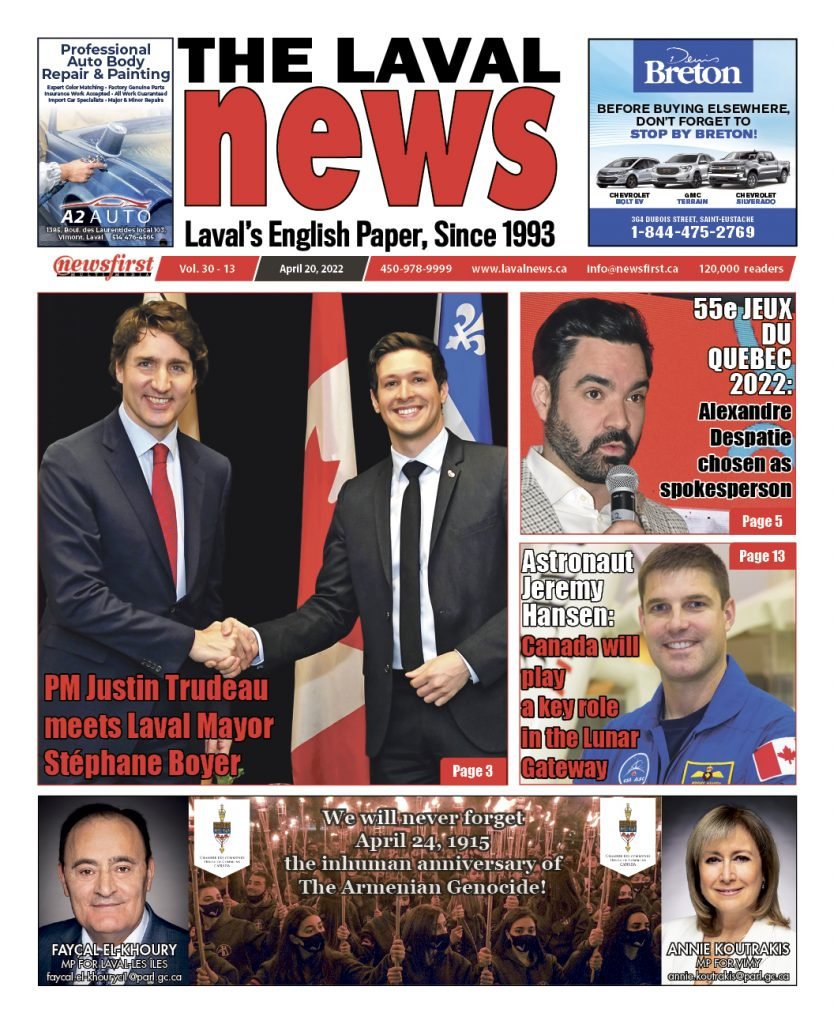
The current issue of the Laval News volume 30-08 published March 2nd, 2022. Covering Laval local news, politics, sports and our new section Mature Life. (Click on the image to read the paper.)
Front page of the Laval News, March 2nd, 2022 issue.
The City of Laval said on Tuesday that snow removal operations are continuing at an “intensive” pace, after nearly two weeks of non-stop work because of a succession of snow and ice storm events over that time-frame.
According to the city’s public work department, another 10 centimetres of snow fell on Laval in the last 18 or so hours, for a total of 38 centimetres since Feb. 18.
Since the city clears snow from its streets on a priority basis, roadways where there are schools, as well as boulevards and other major arteries, are being plowed and cleared of snow before crews get around to residential streets.
Here’s the public works department’s advice to vehicle owners to help optimize the efficiency of snow removal operations:
The city says that “alternative-side” street parking regulations are in effect during snow removal ops, sometimes for several days.
They recommend parking in your own driveway when snow ops are scheduled to take place. Be sure to park 30 centimetres from the curb to leave room for the sidewalk plow.
Be sure to shovel snow onto your property, rather than on the street or sidewalk.
On garbage and recycling pickup days, leave your bins on the edge of your property, rather than on the street or the sidewalk.