1.6 million English-speaking Quebecers ‘deserve respect,’ says Task Force’s Andrew Caddell
A provincial lobby group that promotes bilingualism in Quebec is applauding a decision by judge Sylvain Lussier to force bilingual election information cards to be sent out before the October 5 provincial election.
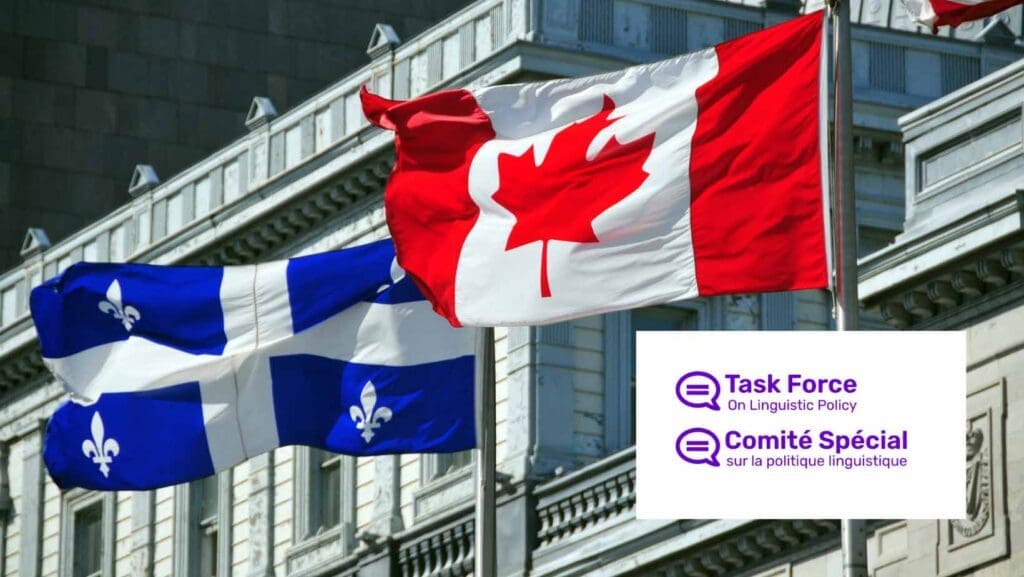
The Task Force on Linguistic Policy has been using legal challenges, public meetings, rallies, expert panels and submissions to governments and the courts to promote bilingualism, inclusion and the protection of linguistic rights across Quebec.
Task Force president Andrew Caddell pointed out the organization was a leader in the bilingual information card issue, which called for an injunction against the decision by Élections Québec to issue all information in French.

Task Force led case
“Congratulations to lawyers Doug Mitchell and Eric Maldoff, who brought the initiative to court,” Caddell said in a statement issued last week, while noting that Task Force vice president Geoffrey Chambers was the plaintiff in the case.
“We have been calling this decision voter suppression from the very beginning, and we have been joined by commentators and public officials across Quebec and Canada,” added Caddell.
He said the decision sends a message to Premier Christine Fréchette, French Language Minister François Roberge and French Language Commissioner Benoît Dubreuil, “who deliberately prevented bilingual information,” Caddell maintained.
“There are 1.6 million English-speaking Quebecers who deserve respect,” said Caddell. “As citizens and taxpayers, they should be treated equally with every other Quebecer.”
Vulnerable Anglophones
Although the CAQ government had said a QR code in the election information would be satisfactory for English-speaking Quebecers, Caddell responded:
“While the vast majority of Anglophone Quebecers are bilingual, many who are not are the most vulnerable: the elderly, indigenous people, visible minorities, the rural poor and people with physical and mental challenges. Many do not have smart phones and are not capable of using a QR code.”
In a phone interview late last week with Newsfirst Multimedia, Caddell said what astonished him most about the situation was the CAQ government’s determination to ignore Élections Québec’s recommendation that the English-language text be included in the pre-election materials.
CAQ ignored Élections Québec
“They first started writing to them in 2023,” he said regarding the provincial election office’s intervention. “And the last letter was the eighth of April 2025, which is when they last wrote to them and they continued to say no.”
While noting that Élections Québec is supposed to be an autonomous body at arm’s length from the provincial government, Caddell said the CAQ government passed Bill 96 (which he dismissed as unconstitutional), making Élections Québec subject to the reform of Bill 101, Quebec’s original French language protection legislation.
“So, Élections Québec had to ask the minister if they could get an exemption from the Charter of the French Language to do what they’ve always done in the past – and which is in line with Section 133 of the constitution and Section 3 of the Charter – where one affirms English-language rights and the other affirms voting rights.”
Bill 96 challenge still in play
The Task Force currently has a major court case still in motion to challenge Bill 96. They are hoping to be allowed to invoke a legal principle set by the Supreme Court of Canada in 2016 when the “Jordan rule” established a framework for numerical ceilings to go to trial within a reasonable time after charges are laid to the conclusion of a case.
“We submitted our brief on January 31 more than two years ago and we have yet to hear from the Quebec government as to how they are going to respond,” Caddell said. “Like that is a delay that is far too great. And the issue is, I think what is happening is they’re waiting until the decision on Bill 21 on the notwithstanding clause has been decided by the Supreme Court.
Notwithstanding ‘irrelevant,’ Task Force claims
“But our case shouldn’t be determined on the basis of the notwithstanding clause, because we argued that the notwithstanding clause is actually in some ways irrelevant to the issues that we’re raising,” he continued.
“Because we’re raising issues about different parts of the constitution, and we’re also saying that the charter itself and the notwithstanding clause should be put aside, because the charter itself does not change any laws that already exist.”
Caddell said the Task Force’s view is that the government should have given them a court date sooner, “but we’re still waiting.” He said the Task Force has no intention of giving up on the issue until they’ve exhausted all legal avenues.