‘It was truly chaotic,’ Fabreville man complains to council after recent snow and ice storms
The City of Laval’s ability to properly maintain its sidewalks and roadways with salt and abrasives during the challenging winter months was closely questioned by several residents during the January 13 meeting of city council.

“Over the last few weeks, there were several instances of black ice which transformed various streets and sidewalks in the City of Laval, making them chaotic for the residents and also for motorists,” Jean-Claude Clerger of Russell St. in Fabreville told the mayor and councillors during the question period.
Could anything be done?
Clerger said he had personally fallen on the ice, nearly breaking a leg. He asked Yannick Langlois, the city councillor for the district of l’Orée-des-Bois, “Was there not something that could have been done as a prevention to avoid this kind of catastrophic situation? Because it was truly chaotic.”
He asked Councillor Langlois whether he was satisfied with the current situation. “Shouldn’t the city be doing more when it is faced with situation like this?” He also asked Mayor Stéphane Boyer what the city plans to do to improve security.
Another resident, Mrs. Guirlande, asked what alternative measures the city uses to neutralize ice on streets and sidewalks when the temperature is too low to allow salt to be used.
Is equipment lacking?
She also asked whether the city has a sufficient amount of equipment (especially abrasive spreaders) to deal efficiently with periods when sidewalks and streets ice over. And finally, she asked how the City of Laval matches up to other large cities for dealing with ice storms.
Another resident who sent in a question by e-mail complained that over the last five years he has lived in Laval, he’d become discouraged by the City of Laval’s failure to listen to complaints about snow and ice removal, as well as other issues at other times during the year.
“The snow gets picked up only once each season, and this is after several complaints, which does not help traffic flow and parking,” he said. “The city does not put salt down after snow removal, which complicates the situation for pedestrians and especially children while increasing the risk of falling.”
Strategy under review, says Langlois
He went on to say that recycling and garbage removal trucks are also hindered, while school bus traffic adds to the danger on streets that haven’t been properly cleared of ice and snow.
Responding to the questions over problems in his district, Councillor Langlois maintained, “We have one of the most productive sectors among the municipal garages in our area. Sector four is envied by many of my colleagues and it is very much up to the task.
“However, you are right, not everything is perfect, and we have decided to review our strategy for the snow and the ice,” he added, while pledging to go out and see for himself on specific streets “and take whatever actions would be necessary if that is the case.”
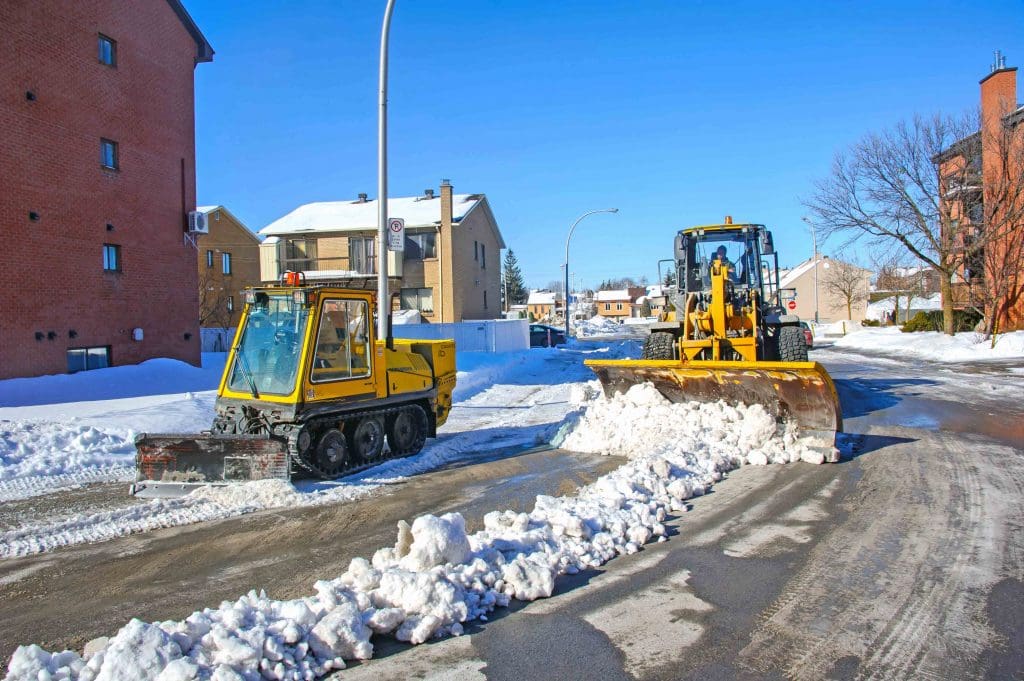
Mayor Boyer said that given the average wintertime weather conditions, the city can’t get all its streets cleared of ice and snow within 24 hours, and so has to prioritize them.
Snow removal priorities
Among the first to be cleared are those adjacent to schools and hospitals, as well as boulevards and autoroute entrance ramps, followed by collector streets and finally residential avenues.
“All of this takes several days,” he said. “Snow removal is always difficult because we would rather everything could get done quickly, but logistically it’s impossible. And it’s noteworthy that it’s no different in other cities in Quebec.”
According to the mayor, several days of storm activity in a row can substantially slow down the snow and ice clearing operations, made all the worse by the fact that under those circumstances public works crews have to return to the top priority areas before they get around to the lower priority ones.

Costs are another factor, Mayor Boyer continued, with the average bill for a single snow removal operation being around $5 million.
Also a money issue
For that reason, he suggested, a decision might sometimes be made (when a second storm is expected soon after a first storm, or a temperature increase is coming) to delay snow and ice removal operations in order to save money for taxpayers.
He also acknowledged that when the temperature goes down drastically, as it did a few days after New Year’s, immediately following a thaw, salt spread on the sidewalks and streets works far less efficiently – “although that doesn’t mean we don’t use it,” Boyer said.
Action Laval city councillor for Saint-François Isabelle Piché said the opposition party had received complaints about poor ice and snow removal in recent weeks from several Laval districts, including Fabreville.
She noted that the city’s public works department had several pieces of its salt spreading equipment out of action at the time, while blaming it on “poor planning” by the Boyer administration.
Consultation sought on mini-farm closing
Also during the council meeting, Councillor Piché tabled a resolution calling on the city to hold a public consultation on the future of the mini-farm at the Centre de la nature, which the Boyer administration plans to close as a cost-saving measure.
The resolution proposes “that the executive-committee mandate the City of Laval’s general management to hold a public consultation regarding the future of the Centre de la nature’s small farm, including options for maintenance, renovation, relocation or partnership, before any final decision is made regarding its closure or transformation, and that the results of this consultation be made public and presented to city council.”