Home Blog Page 135

Executive-committee approves grants to 4H and for conservation

During their Sept. 29 public meeting, the members of the City of Laval’s executive-committee decided to provide subsidies to help promote the use of wood for various purposes, while also providing sums to promote the conservation of some underused forestlands on Laval’s territory.

In accordance with a provincial program for managing wildlife, parks and forests, the members of the executive-committee awarded a subsidy of $118,000 to the 4H Clubs Québec in order to encourage the use of wood in Laval.

With the money, 4H Clubs Québec is expected to develop several projects for the education and familiarization of the public to the value of wood. As part of the program, they will be doing the following:

  • Leading awareness-raising activities on the recovery of wood in Laval, as well as the value of wood as a forest resource impacted by climatic changes;
  • Produce teaching tools, while raising awareness among people in Laval;
  • Develop awareness-raising activities on the transformation of wood during major events;
  • Develop educational programs on how wood is transformed from beginning to end, and how climate change is affecting it.

Conservation program approved

The executive-committee decided to associate the city with the Société d’histoire naturelle de la vallée du Saint-Laurent (SHNVSL) and the Fondation de la faune in order to carry out a conservation project aimed at analyzing the potential for connecting Laval’s open nature areas to other green spaces on the island.

The project in question fits in with Laval’s standing plan for the conservation of its natural spaces, as well as the Montreal Metropolitan Community’s Trame verte et bleue program.

In Laval, the SHNVSL’s conservation project is expected to have a positive impact on a multitude of animal and vegetation species that live in Laval’s woods, including birds, pollinating insects, but especially brown snakes which are currently in decline in Quebec but remain present on Laval’s territory.

Executive-committee members

The City of Laval’s executive-committee meets each week to make decisions on a variety of issues. The executive-committee includes the following people: Mayor Marc Demers, vice-president Stéphane Boyer (also councillor for Duvernay–Pont-Viau) councillors Sandra Desmeules (Concorde–Bois-de-Boulogne), Ray Khalil (Sainte-Dorothée), Virginie Dufour (Sainte-Rose) and associate member Nicholas Borne (Laval-les-Îles).

City says street parking in Laval will be easier this winter

The city has announced that from Oct. 1 until the end of the coming winter, it will be possible to park on two sides of the street throughout Laval when snow removal operations are not underway.

The new policy is an important shift from the old way of parking during the winter, when car owners were expected to park on alternate sides of the street throughout the winter whether snow removal was taking place or not, drawing numerous complaints over the years.

The city says that with the help of special information resources, it will be keeping residents informed when parking on one side of the street will be prohibited during snow removal operations. The rest of the time, they will be able to park without hindrance from Oct. 1 to April 30.

In targeted areas, which is around 85 per cent of Laval’s territory, new street signs providing information on the new parking rules have been added to existing signage. The city says that alternating from one side to the other is now only applicable during street maintenance operations, and there is a phone number to call if necessary. “I am very happy to see the reflections and public consultations undertaken by the city with teams of professionals becoming a reality in order to answer to the parking needs of citizens,” said Mayor Marc Demers. “With this new way of doing things which has been tested with earlier pilot projects, car owners in Laval will more easily be able to park during the winter season.”

A Pandemic of the Unvaccinated, and Tip Toe Through the Tulips with China

It’s obvious to anyone treating Covid infected patients that those taking up hospital beds and ICU departments are the unvaccinated. Meanwhile, the vaccinated, waiting for urgent surgery, albeit elective, continue to suffer waiting for the un-vaccinated to get vaccinated, to free up beds, relieve pressure on our doctors and nurses, and generally, allow entire hospital teams to return to some sane level of operation. To be clear, ‘elective surgery’ does not mean unnecessary or non-urgent. Early diagnosis of cancer for example, can actually lead to a cure, not a treatment. A delay in kidney replacement causes tiring and disruptive daily dialysis much longer than expected. These unvaccinated are getting priority treatment while needy kids and their parents, wait. The cost of anxiety and potential loss of life, is incalculable. One headline recently read, the ‘unvaccinated are getting better treatment than the vaccinated’. How sad, but true.

In Alberta, I watched Premier Brian Kenney at a news conference say the 17% unvaccinated in his western province, make up 92% of Covid infected hospital patients. And the stats may vary somewhat in each province, but the overwhelming numbers point to the fact, yes, the fact, that those who are responsibly immunized, are having their paid medical and surgical care refused. Dr Edward Les, an Alberta pediatric emergency room physician says their tax paid services are “curtailed by the pandemic of the unvaccinated.”

Like you, I need a break from elections. But I’m a bit uncomfortable because of ‘a small stone in my shoe’. I noticed that across the country the Conservative vote plunged in Canada’s most Chinese electorates. At least three Conservative candidates in BC, all Asians, were not re-elected. And one of them has spoken out, Kenny Chiu, the defeated incumbent in Canada’s largest Asian electorate, Richmond BC, blaming Chinese agents who used the social media www.wechat. com, to spread misinformation. More to the point, Chinese agents in Canada are messaging lies. Chiu presented a private members bill to form a registry of foreign agents in our country, much like the United States and Australia have already done. He ought to be congratulated, not chastised. He wants an investigation. The Conservatives were the only party prior and during the campaign to push Trudeau to stand up to China. And Canadians expect that.

‘Like you, I need a break from elections’

The Chinese use coal as their primary source of energy. And they are running out. They actually are experiencing an energy crisis. Black outs are everywhere in that country these days. They don’t care about pollution, much less about climate change. Short of resources to feed a hungry nation, they have now partnered with Russia to mine Afghanistan with a giant corporation called China Africa Resources. It’s easy to understand why Russia, China and the Taliban, are just one big happy family.

So why is Justin Trudeau so soft on Asia? Why has this liberal government not yet told China we do not want your military-owned Huawei as part of our 5G grid, the only western country to stall on what should be an obvious decision? The reason is the following. Mr. Trudeau admitted to a CTV question period during his leadership race “Obviously, my family has historical ties with China.” And add to that, the old Liberal party guard “has close and lucrative ties to corporate interests that are deeply invested in trade relations with China” wrote the National Post. Most recently our foreign affairs minister Francois-Philippe Champagne was forced to payoff the $1.2 million dollar balance owing on his house mortgage held by the Bank of China. It’s only a small example of what Canadians know about the relationship our political elite have with China. And it should make it amply clear why Mr. Trudeau tip toes through the tulips with China.

I hope our tax dollars reach those to whom they were intended. A recent federal court decision, awarded $billions to native children who suffered discrimination in the welfare system. It’s fair to continue to ask where all federal funds end up. During the debate Trudeau proudly talked about the billions allocated to natives across the country, but was quickly flagged by the guest native moderator who questioned not the amount, but its minimal results. This year, another 25 billion dollars will be allocated to address native issues, but the question remains if this will reach the people to whom it was intended. Every federal auditor general in recent memory has identified an “incomprehensible failure” of the Indigenous Affairs bureaucracy. There is absolutely no accountability, nor any cap on increased yearly spending as there was under previous governments. No one monitors the results of these enormous expenditures, despite the added abuse and corruption of a few Chiefs. It’s no wonder natives still complain about not having safe drinking water, poor housing and education. There was nothing wrong with our Fiscal Accountability Act, scrapped by Trudeau. Bring it back. Canadians want value for their buck, and need to know where their money is going.

That’s what I’m Thinking.

Robert Vairo

robert@newsfirst.ca

City officials cave in to 100th Ave. ‘lane reduction’ petitioners

Unpopular traffic calming measure won’t be back next spring, say Khalil and Dib

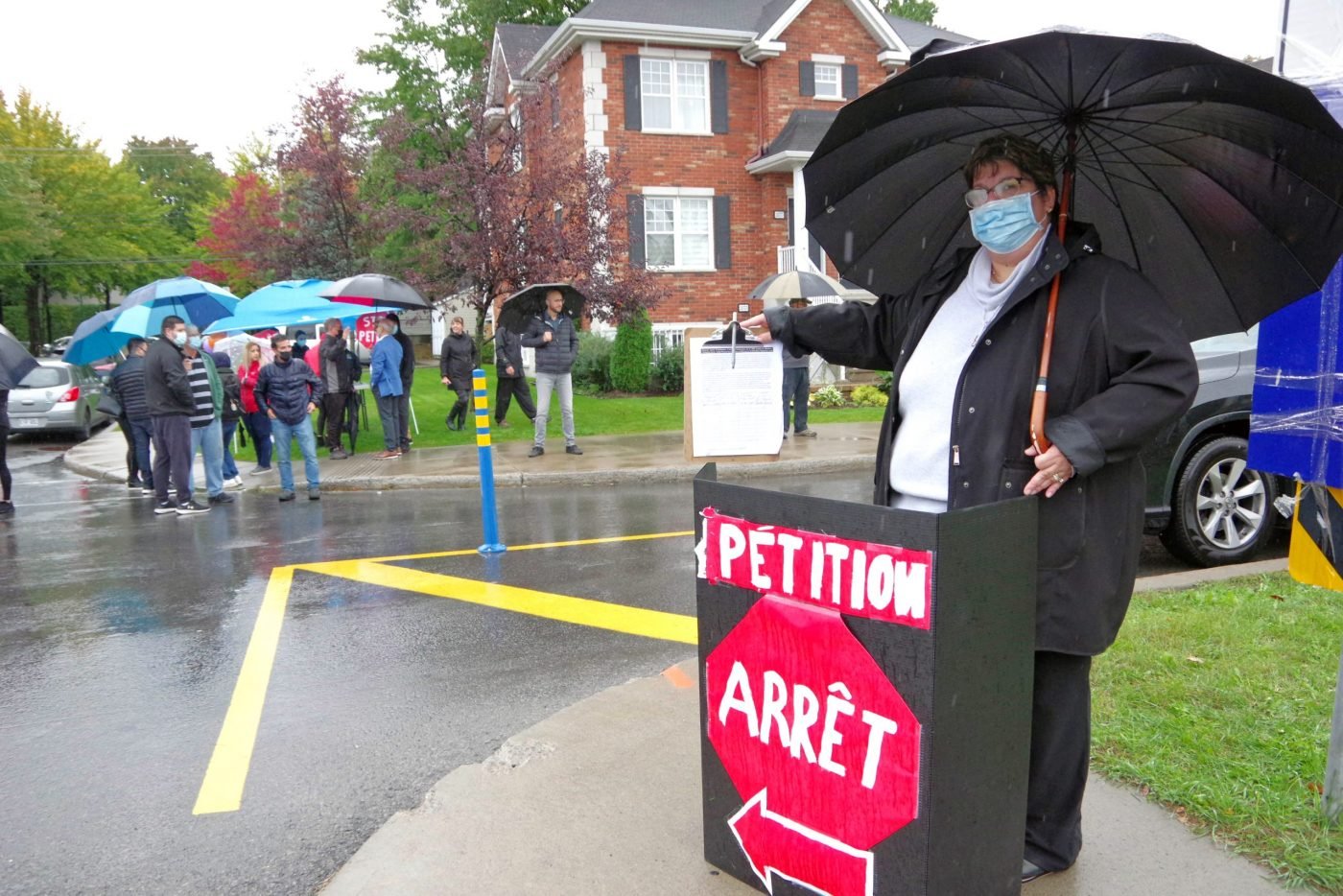
A simmering dispute between the City of Laval and some Chomedey residents over traffic calming near the corner of Hurtubise St. and 100th Ave. reached a boiling point last Saturday when dozens of supporters signed a petition demanding the traffic department remove “lane reduction” markings that were painted onto the street in hopes of slowing speeding motorists.

According to Peter Caruana, who started the petition with his daughter Gabrielle, he and others had been complaining that a stop sign should be put in at the corner to replace yellow lines and traffic bollards the city painted on 100th between Couturier and Hurtubise to slow cars down by reducing the traffic flow to one lane.

Simple solution wanted

Caruana said a stop sign that used to be in place at the corner was removed around a decade ago. “What we want is a simple thing: a three-way stop sign,” he said in an interview with The Laval News. “It would help ease the pain.

“It would slow the race track that we have here now,” he added, noting that this section of 100th Ave. has become a virtual drag strip for an increasing number of motorists who’ve discovered that the three-kilometre-long street beginning at Samson Blvd. in the south has become a handy shortcut to get to Autoroute 440 at the north end.

Another resident, Jim Katsigiannis, who’s lived in the neighbourhood 27 years, agreed that ever since 100th Ave. was opened up from Saint-Martin Blvd. northward towards the A-440, 100th has become a speedway. “The police can only do so much,” he said.

Traffic makes its way northward on 100th Ave. between Couturier and Hurtubise, with the controversial closed lane for traffic calming on the right of the photo. (Photo: Martin C. Barry, Newsfirst Multimedia)

‘It’s not working,’ said Dib

The elected official responsible for the area, Saint-Martin city councillor Aline Dib, was invited to the gathering by the petition organizers. Several candidates running for city council or for the mayoralty in the Nov. 7 election also turned up. “I had a lot of complaints about speeding and racing and the people called the city about this,” Dib said.

She said a city council traffic committee set about to resolve the problem. They came up with the idea of closing the north-bound left-side lane beginning at Couturier. “But I’m telling you, it’s a pilot project,” she insisted. “So, now we’ve figured out it’s not working. So, we are working to find help and to give solutions.”

Sainte-Dorothée city councillor Ray Khalil, who sits on the executive-committee with responsibilities for traffic engineering issues, said he was aware of the complaints over speeding, and that some residents had suggested a new stop sign would be the right fix.

Stop signs not obeyed

“But we’ve had past experience in the area where people were burning through stop signs,” he said. “So, what the services said is instead of adding a problem to a problem, let’s try a measure that’s a bit more aggressive, like a calming measure, in order to slow down traffic. But we’ll do it just with paint and bollards just to test it out and see how it goes, the winter is coming, we know we have to remove it for snow clearance, and we’ll see how people react to it.”

Residents from near the corner of 100th Ave. and Hurtubise St. turned out in large numbers last Saturday to sign a petition demanding the removal of a traffic calming pilot project at the corner. (Photo: Martin C. Barry, Newsfirst Multimedia)

Khalil said if the pilot project had answered to the demand for slowing the speed and was judged satisfactory, then the city would have proceeded with something more permanent eventually. But if not, they would at least have learned from applying a traffic calming method other than a conventional stop sign.

However, after implementing the measure, Khalil said that what the city realized was that because of the configuration of houses along 100th Ave., the lane reduction “wasn’t ideal and was causing other types of issues.

‘We’ll re-evaluate,’ said Khalil

“So, I don’t think it will be kept in the future,” Khalil added. “We’ll re-evaluate. We’ll go back to the drawing board and see how we can answer people’s needs for slowing down traffic, but also having the fluidity of coming in and out of the sector.”

Councillors Dib and Khalil gave their assurances that the painted areas and bollards were going to be removed by the city before winter in any case to allow for proper snow removal, and that they won’t be restored next spring.

Some residents say that ever since 100th Ave. was opened up from Saint-Martin northward towards the A-440, 100th has become a speedway

Nicolas Macrozonaris, who is running for Action Laval in Saint-Martin, agreed the pilot project should be cancelled and the traffic calming infrastructure removed immediately.

“This is very unpopular,” he said. “When people are complaining about it – and citizens are putting together a petition today on their day off – it means it’s extremely unpopular and probably also unsafe.”

Laval News Volume 29-34

0

The current issue of the Laval News volume 29-34 published October 6th, 2021.
Covering Laval local news, politics, sports and our new section Mature Life.
(Click on the image to read the paper.)

Front page of the Laval News.
Front page of the Laval News, October 6th, 2021 issue.

Laval Police scores big with its ‘Living Radars’ project

In the course of a recent security campaign around schools, the Laval Police Dept. felt they wanted to make more than the usual impact on motorists whose attention isn’t always easy to attract.

‘Living Radars’

What they came up with was imaginative, to say the least: Living Radars. School age children wear back packs with large luminescent displays indicating the speed at which motorists are travelling.

The concept was inspired by a promotional campaign first undertaken by the Société d’assurance automobile du Québec (SAAQ). So far, two such living radars have been used in Laval during the 2021 back-to-school period this fall.

Lightweight radar

The units, made like school bags worn on the child’s back, are adjustable to the size of children and contain a functioning radar mechanism, as well as a lightweight illuminated panel that posts the speed of passing cars.

Over the past few weeks, several children tried out the Living Radars, while accompanied by a police officer. Regarded as a preventive tool, the LPD confirms that they do indeed draw the attention of motorists and succeed in slowing them down.

To be re-deployed

Developed in conjunction with the traffic management technology company Trafic Innovation, the Living Radars will be used by the LPD over three future phases of their safety campaign, in November, next February and next April.

The LPD points out that in addition to the SAAQ’s participation in the project, two school boards, those being the Centre de services scolaire de Laval (CSSL) and the Sir Wilfrid Laurier School Board (SWLSB), also participated.

Safety campaign ongoing

To date, according to the LPD, the police have made 260 visits to school zones at 67 schools in Laval during their back-to-school safety campaign.

The LPD has placed a video online on their Facebook page to provide information on the campaign, and additional videos are expected.

Over the coming weeks, the police will be watching the streets and roads around schools to make sure all rules and regulations are being observed by motorists to ensure the safety of school children.

Incumbent SWLSB chairman Paolo Galati re-elected

‘Success for All’ team leader begins his second term

According to polling results for the 2021 Sir Wilfrid Laurier School Board elections on Sept. 26, incumbent chairman Paolo Galati won the race, outpacing challenger Noemia Onofre de Lima.

In the 2021 board elections, the first in a good number of years, voters were called upon to cast votes only for the chairperson position, as all the board commissioners had been acclaimed in September 2020.

The outcome was confirmed at SWLSB headquarters in Rosemère by Cliff Buckland, the returning officer for the 2021 school elections.

For Galati, who was first elected chairman in October 2018 and who ran under the banner of his Success for All team, it marked the beginning of a second term. “Firstly, I would like to congratulate my opponent on her campaign,” he told the Laval News the day after the vote.

“A variety of opinions have been voiced and democracy has been served,” he continued.

“I am pleased that the electors of the Sir Wilfrid Laurier School Board have entrusted me with this second mandate and I am already back at work.”

For her part, Onofre de Lima said she was “not surprised” by the outcome when she was contacted by the Laval News.

“Nothing has changed,” she said. “The board has been like that for many years.”

The final tally of votes was as follows:

GALATI, Paolo Success for All—Team Galati: 1148.

ONOFRE DE LIMA, Noémia: 250

The number of registered electors was: 43,131. The number of electors who voted was: 1,412. The number of valid ballots was: 1,398. The number of rejected ballots was: 14.

UMQ warns CAQ not to disturb ‘linguistic peace’ with Bill 96

Uncertainty whether some bilingual municipalities will be keeping their status

While saying they agree generally with the CAQ government’s Bill 96 to strengthen Quebec’s French Language Charter, the Union of Quebec Municipalities is advising the provincial government to tread carefully so as not to disturb the “linguistic peace” in municipalities that have bilingual status under the current charter.

The UMQ presented its brief on Quebec’s controversial new language legislation last week to the National Assembly’s Committee on Culture and Education.

Bilingual status issue

Although neither the summary of major points nor the conclusion in the UMQ’s brief referred to the bilingual status issue, item one in their document stated that “the measures foreseen in new articles 29.2 et 29.3 appear to be satisfactory since they will allow them [municipalities] to maintain this status.

“They will thus be able, based on our of the proposed legislation, to continue to offer services in English to their Anglophone population as they do currently.” The UMQ presently has around 30 members which are recognized by Quebec as having bilingual status.

Questions Rosemère’s status

While the CAQ government pledged early on to continue allowing bilingual status in municipalities where it is warranted by at least 50 per cent English-speaking residents, there is concern the government may fine tune some elements of Bill 96’s final draft, potentially impacting currently bilingual municipalities where the number of Anglophones has fallen well below half.

Although several Committee on Culture and Education members raised small points about the UMQ’s brief, Parti Québécois MNA for Matane-Matapédia Pascal Bérubé was much harsher in his scrutiny.

“So, you find it acceptable that a municipality that has only 12 per cent Anglophones can have bilingual status?” he said, referring to the Town of Rosemère on Montreal’s North Shore.

Employment issues

UMQ president Daniel Côté (who is the mayor of Gaspé in Quebec’s Gaspésie region) said that based on the currently prevailing rules, which include recognition of an acquired right, he had no problem with it, if the municipality itself wishes to retain its bilingual status.

Bérubé continued, “If I were to suggest to you that I have here in front of me an employment offer from a municipality that has 12 per cent Anglophones and that is demanding bilingualism as one of three conditions for employment that ended last Aug. 20, do you still find that acceptable?”

Municipal autonomy

Côté answered, “From the point of view where we strive as much as possible to preserve municipal autonomy, while also respecting other linguistic requirements of course, it is municipal autonomy that gets priority, as far as I am concerned.”

Bérubé pointed a finger at a second Montreal-area municipality that has bilingual status – Town of Mount Royal.

While maintaining that TMR’s English-speaking population now stands at 18 per cent, he noted (again citing a recent employment offer) that in order to get a job with the town’s public security department, applicants are asked to be proficient in spoken and written English.

‘Unacceptable,’ said Péquiste

After Côté confirmed again that bilingual municipalities have the legal right to operate like this, Bérubé commented: “I don’t know whether it’s linguistic peace you’re out to preserve or peace in your organization.

“But as concerns us, municipalities that have less than 20 per cent [English] in their population and that want to demand knowledge of English for employment, this is an obstacle. This is unacceptable in Quebec.”

In its brief, the UMQ, representing 85 per cent of the population in municipalities across Quebec, recommended that Minister Responsible for the French Language Simon Jolin-Barrette allow the province’s towns and cities an adjustment period so that they can conform to new measures after Bill 96 is passed.

Impact on city contracts

In another recommendation, the UMQ expressed concern that new language requirements applying to municipal administration might lead to the automatic cancellation of certain major contracts awarded by municipalities should the wording of the contracts (some of which might be with suppliers outside Quebec) fall short of new French-language requirements spelled out in Bill 96.

The UMQ expressed concern that an overly rigorous Bill 96 restricting the use of English could potentially harm people who are vulnerable

In their brief, the UMQ also expressed concern that an overly rigorous language law restricting the use of English could potentially harm people who are vulnerable.

Impact on the vulnerable

“In as much as it is our wish that the entire population can communicate easily in French with their municipality, this is unfortunately not yet possible for a number of people, notably for those who have arrived more recently in Quebec or who are older,” the UMQ brief stated.

“They can run into significant difficulties in understanding certain administrative documents, leading them to call the municipality to obtain information.”

Regarding the impact of Bill 96 on administrative matters in municipalities, the UMQ noted that Section 1 of the proposed law would allow the provincial government to demand the annulment or the suspension of the execution of any outsourced contract that didn’t meet Bill 96’s more exacting French language standards.

QESBA asks CAQ government to drop ‘notwithstanding’ sections from Bill 96

‘You don’t believe there is a decline in French,’ language minister tells Anglo school boards

In a brief presented by the Quebec English School Boards Association to officials in Quebec City last week during public hearings on the CAQ government’s controversial updating of Bill 101, the QESBA recommended that several sections of the Quebec Charter of Human Rights and Freedoms and the Canadian Charter of Rights and Freedoms be removed from Bill 96 when invoking the “notwithstanding” clause.

Not by infringing

“The Quebec English School Boards Association and our nine English language school boards believe in the need to promote and protect the French language in Québec and indeed throughout Canada,” QESBA president Dan Lamoureux and executive-director Russell Copeman said in the 16-page document they tabled.

“We were the pioneers of French immersion, bilingual programs and now what we call Français Plus. We ensure the success in French for all our students and prepare them to live and work in Québec with pride.

“But that protection and promotion should not be done by setting aside the fundamental rights of Quebecers, nor by infringing on the rights of the English-speaking community of Québec. We ask that the government reconsider some of the provisions of Bill 96.”

‘Never been more French’

Although the QESBA acknowledged that the French language is in a minority position in Canada and North America, and that the QESBA recognizes that legislative, regulatory and collective efforts are needed to protect and promote French in Quebec and Canada, they said they felt compelled to observe, while citing corroborating statistics, that by many measurable criteria “Québec has never been more French than today.”

QESBA executive-director Russell Copeman declined to comment on French language minister Simon Jolin-Barrette’s suggestion that use of the French language is receding in Quebec.

As well, the brief continued, “the protection and promotion of the French language in Québec should not be done by infringing on the Québec Charter of Human Rights and Freedoms,” nor “at the expense of the rights of English-speaking Quebecers and their institutions, including our Constitutional rights to control and manage our school system by virtue of section 23 of the Canadian Charter of Rights and Freedoms.”

A basic incompatibility

Regarding Section 159 of Bill 96, which unilaterally amends Canada’s Constitution Act of 1867 by adding sections stating “Quebecers form a nation” and “French shall be the only official language of Québec” and “the common language of the Québec nation,” the QESBA said “this section of Bill 96 seems to be incompatible with section 133 of the Constitution Act 1867 which allows bilingualism in the Québec legislature and in federal and Québec courts.”

In addition to these claims, the QESBA maintained that proposed new restrictions in Bill 96 on eligibility for English schooling could adversely affect enrolment in the Anglophone system and discourage foreign nationals from moving to Quebec.

Impact on enrollment

Bill 96 seeks to amend the Charter of the French Language to specify that English-language education certificates for dependent children of foreign nationals temporarily living in Quebec will apply for three years only. Under the present system, the certificates can be renewed as long as the status of the parent remains unchanged.

Although the amendment would affect only foreign nationals, the QESBA asked the government to scrap the clause because of the potential effects on already dwindling enrolment in the English school system. They said it would also hurt Quebec’s ability to recruit foreign talent.

QESBA mute on French decline

Quebec Minister Responsible for the French Language Simon Jolin-Barrette asked Copeman whether the QESBA recognizes that the use of French in Quebec has been declining. “We are not demographers or sociologists,” Copeman replied, basically repeating what the QESBA stated in its brief.

“As we stated in our memo, we will not get drawn into a discussion on the relative decline of French … Are there situations on the island of Montreal? Are there situations elsewhere? Possibly, but this is not our area of expertise. We are here to talk about the impact of Bill 96 on the school network.”

French threatened, said minister

Jolin-Barrette persisted. “So, as I understand it, you don’t believe there is a decline in French,” he said. “Because in Quebec society now, there is quite a bit of consensus to the effect that effectively statistical studies demonstrate – whether it’s the OQLF or the Conseil supérieur de la langue française – that there is a decline in French and that French will continue to decline if no measures are taken.

“So, I understand that your organization is not specialized in demographic data. But does your organization acknowledge this decline?” Copeman suggested he had little choice but to give approximately the same answer to what was essentially the same question rephrased.

And the Quebec Nation?

However, the Minister Responsible for the French Language hadn’t finished. Noting that the English Montreal School Board (the largest member of the QESBA) had recently denied in a resolution the idea of Quebec being a nation, Jolin-Barrette said he was curious to know what the QESBA thought of that position.

‘The protection and promotion of the French language in Québec should not be done by infringing on the Québec Charter of Human Rights and Freedoms,’ said the QESBA

“I think that even as the chairman of the English Montreal School Board himself admitted, the initial resolution was ill-advised,” Copeman responded.

“This is a conclusion that we share. And the council of commissioners at the English Montreal School Board manifestly came to the conclusion that the resolution was ill-advised, because they annulled it. So, for me that’s the end of the story.”

Laval executive-committee approves improved swings for parks

During their Sept. 22 public meeting, the members of the City of Laval’s executive-committee voted in favour of buying new and specially-adapted playground equipment for parks, approved new measures to embellish the bicycle path on des Bois Avenue, and voted in favour of new fitness equipment to be installed on the edge of the Armand-Frappier woods.

With the stated goal of making Laval a city that’s more welcoming, fair and inclusive, the executive-committee decided to issue a contract for $106,250 to Tessier Récréo-Parc for the installation of 11 swings with specially-adapted seats at 11 different park sites.

According to the city, the swings are designed to accommodate a greater range of people, based on their physical abilities. The swings are being installed in existing parks and their seats will be coated in a special abrasive to ensure safe contact. The swings are expected to be installed before winter.

Fence to be installed for des Bois Ave. bike path

Continuing some work already begun by the city on des Bois Avenue in Laval-Ouest, the executive-committee members also decided to relocate a cycling path and to install a fence to ensure the safety of bicyclists and pedestrians.

In order to embellish the area, the executive-committee members also approved the disbursement of $115,487 for landscaping. Vines will be added to the fencing to conceal the fencing material, and the bike path itself will be improved with flower beds alongside.

New fitness gear at Armand-Frappier woods

Finally, the executive-committee decided to award a $105,489 contract to Construction Vert Dure to install physical fitness and training equipment modules on the edge of the Armand-Frappier woods where there are walking paths.

According to the city, the purpose of the fitness equipment is to enhance the exercise that walkers on the paths at the woods are already receiving.

In addition, the city is undertaking work to improve access to the paths and the woods with some extra landscaping at the entrance on 65th Ave. and the development of a new walking path near a Hydro Quebec power line.

Executive-committee members The City of Laval’s executive-committee meets each week to make decisions on a variety of issues.

The executive-committee includes the following people: Mayor Marc Demers, vice-president Stéphane Boyer (also councillor for Duvernay–Pont-Viau) councillors Sandra Desmeules (Concorde–Bois-de-Boulogne), Ray Khalil (Sainte-Dorothée), Virginie Dufour (Sainte-Rose) and associate member Nicholas Borne (Laval-les-Îles).

Quebec shouldn’t seek ‘sovereignty by the back door,’ says Julius Grey

Is disturbed neither National Assembly opposition nor Ottawa have questioned Bill 96

In Bill 96: The perils of ‘pensee unique’ published in the Toronto-based Lawyer’s Daily on May 26 this year, Montreal constitutional lawyer Julius Grey wrote that “Those who consider the proposed Quebec constitutional amendment to be purely declaratory with no effect are confusing the content of the amendment with its insertion into the Constitution.”

Pensée unique?

Perhaps not everyone is familiar with the term pensée unique. When Grey uses it, he is, according to an online encyclopedia, referring to a disparaging expression for mainstream ideological conformism, which is invariably opposed to the views of a dissenting individual.

The expression apparently was popularized by French editor and journalist Jean-François Kahn in the early 1990s, perhaps as he was trying to describe what his English-speaking counterparts had come to refer to as “political correctness.” This, in turn might be understood as a very narrow state of mind that dominates all of an individual’s or a society’s thoughts and actions.

No one questions Bill 96

In his piece, Grey maintains that “we have become a society of pensée unique on controversial questions,” as illustrated by some of the pieces of legislation tabled in the National Assembly lately, and he finds it “disturbing that none of the opposition parties in the National Assembly or the four major federal parties has questioned Bill 96 or even its constitutional change.”

While suggesting that under these conditions some really serious crisis could break out without there being so much as a debate, he said it was to be hoped that Quebec’s and Canada’s judiciary would feel less constrained by “pensée unique,” or political officials’ need to win seats in elections, so that they might “strike down the amendment and declare that the Constitution of Canada continues to apply in its entirety.”

No one disputes ‘nation’

Noting that the House of Commons in Ottawa and the National Assembly in Quebec City both now are in agreement on the idea that Quebec is a “nation” and no one (except perhaps, we might add, a certain English-language school board official) is seriously disputing it, Grey goes on to suggest that Quebec society now does indeed resemble such national states as Denmark or Poland.

‘Bill 96 and its Constitution amendment may well be one of the instalments’ leading towards Quebec sovereignty, says Julius Grey

Although he says one advantage that “nation” status might confer on Quebec is the right of self-determination, he added that “by itself, the recognition of national status adds nothing concrete.” He says that “Support for nationalism is rooted in ‘identity’ not in logic. Whenever ‘national’ concessions are granted they bring no real advantage to those in thrall to nationalism, except perhaps some leaders.”

The Bill 96 instalment

He theorizes that many Quebec sovereignists “now see independence as possible only on the instalment plan,” and that “Bill 96 and its Constitution amendment may well be one of the instalments.”

Finally, while noting that Canada obtained its independence similarly in stages, spaced many decades apart at each stage, he speculates that “if such is the goal of the Quebec government, it should state it frankly and openly and not seek sovereignty by the backdoor. All Canadians of both languages deserve that.”

Weather

Laval
light rain
7.8 ° C
7.8 °
7.8 °
98 %
3.2kmh
100 %
Mon
14 °
Tue
13 °
Wed
10 °
Thu
11 °
Fri
16 °